

Understanding the TLS Handshake and Why Mutual Authentication Matters
Standard TLS, the protocol securing virtually all HTTPS traffic on the internet, provides server authentication: the client verifies the server’s identity through its certificate, but the server has no cryptographic assurance of the client’s identity. Mutual TLS (mTLS) extends this handshake so that both parties present and verify certificates. The server authenticates the client, and the client authenticates the server, establishing bidirectional cryptographic trust before any application data is exchanged.
In a standard TLS 1.3 handshake, the server sends its certificate in the ServerHello, and the client validates it against its trust store. With mTLS, the server includes a CertificateRequest message, prompting the client to send its own certificate. The server then validates the client certificate against its configured certificate authority. Only after both sides have verified each other’s identity does the encrypted channel become available for application traffic.
Free to use, share it in your presentations, blogs, or learning materials.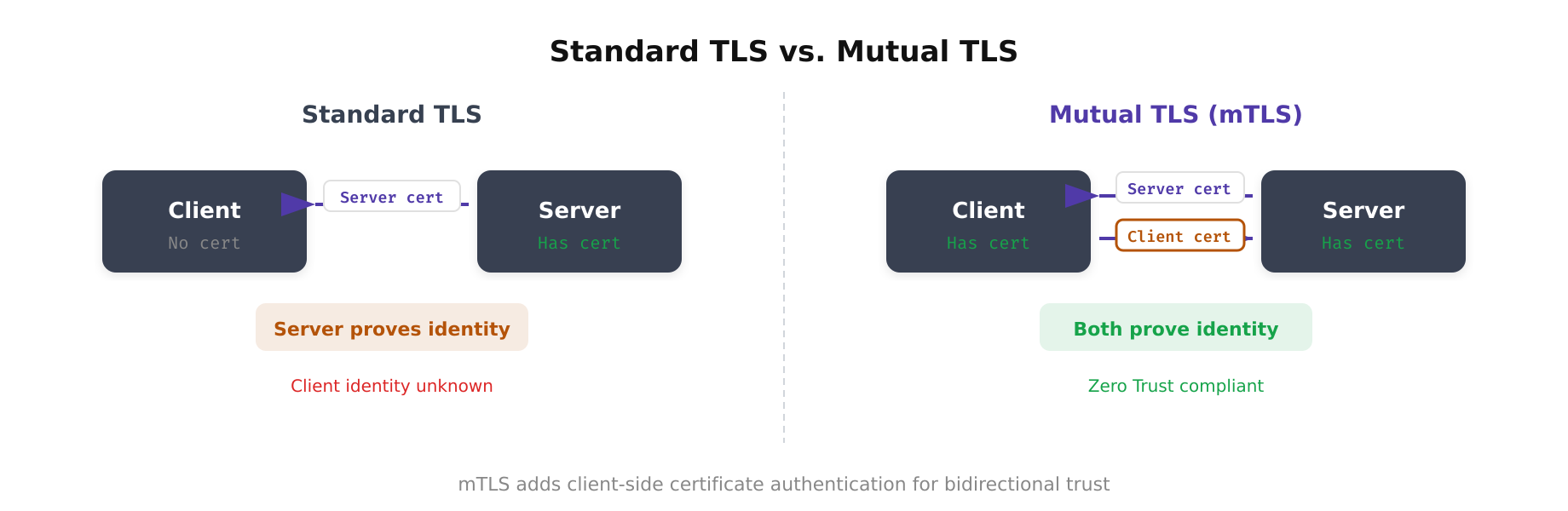
This diagram highlights the fundamental difference between standard TLS and mutual TLS. In standard TLS, only the server presents a certificate and the client remains anonymous at the transport layer. In mTLS, the handshake includes an additional CertificateRequest from the server and a corresponding Certificate response from the client, ensuring both endpoints are cryptographically verified before any application data flows.
The mTLS Handshake Step by Step
The mTLS handshake in TLS 1.3 follows a specific sequence that establishes mutual trust. Understanding each step is essential for debugging connection failures and configuring the protocol correctly.
- ClientHello: The client initiates the connection, sending its supported cipher suites, TLS version, and a random nonce. In TLS 1.3, this message also includes key share extensions for the Diffie-Hellman key exchange.
- ServerHello + EncryptedExtensions: The server selects the cipher suite and key exchange parameters. From this point, all subsequent messages are encrypted using the handshake traffic keys derived from the key exchange.
- CertificateRequest: The server sends this message to request the client’s certificate. It specifies which signature algorithms and certificate authorities are acceptable.
- Server Certificate + CertificateVerify: The server presents its certificate chain and proves possession of the corresponding private key by signing a hash of the handshake transcript.
- Client Certificate + CertificateVerify: The client presents its certificate chain and proves possession of its private key by signing the handshake transcript hash.
- Finished: Both sides exchange Finished messages containing a MAC over the entire handshake transcript, confirming that neither side’s messages were tampered with. The connection transitions to application data encryption.
The entire handshake in TLS 1.3 completes in a single round trip (1-RTT), making mTLS only marginally more expensive than standard TLS in terms of latency. The computational cost is slightly higher due to the additional certificate verification, but this is negligible on modern hardware.
Free to use, share it in your presentations, blogs, or learning materials.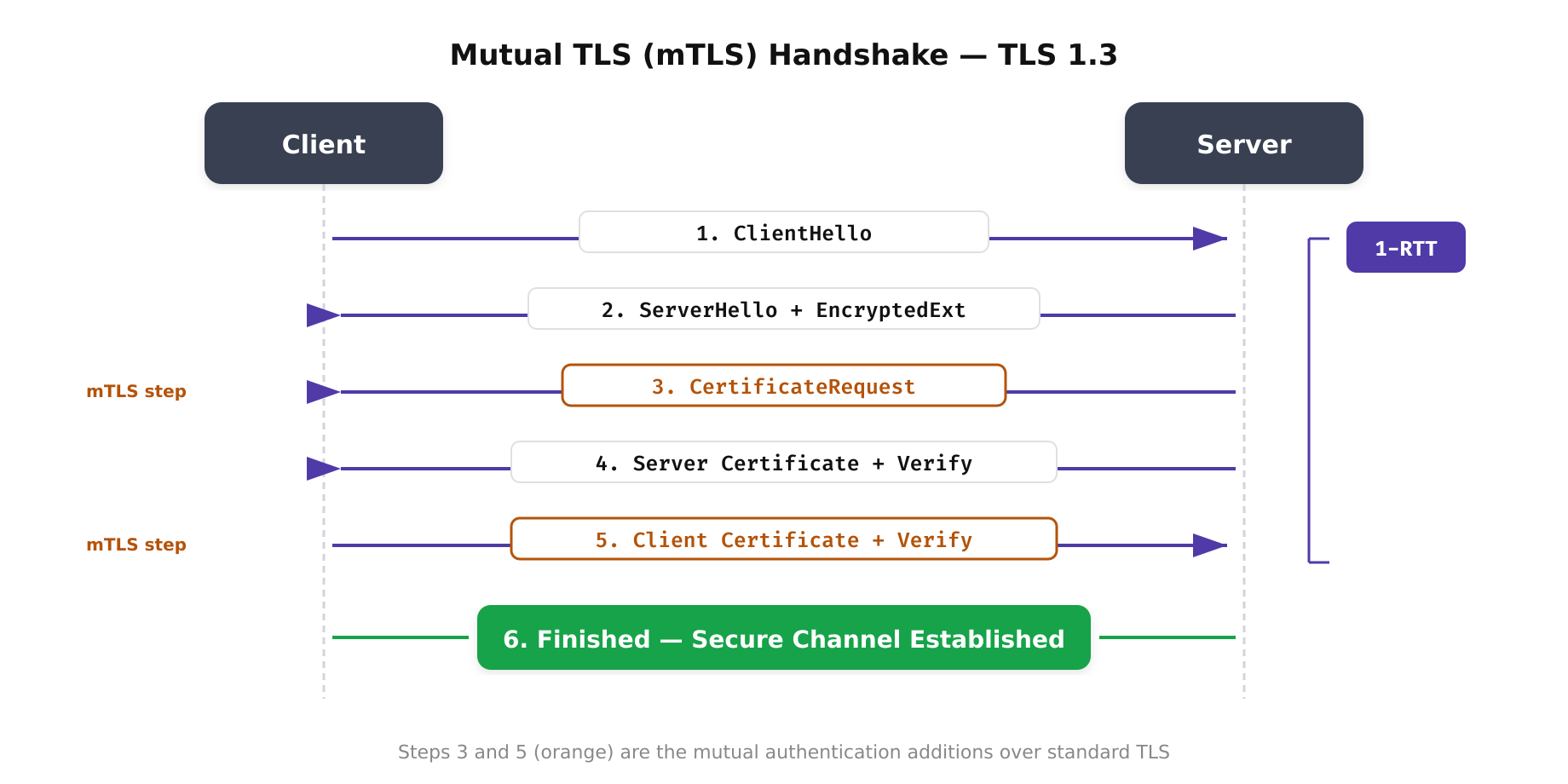
The above illustration walks through the six steps of the mutual TLS handshake under TLS 1.3. Unlike standard TLS where only the server presents a certificate, mTLS requires the client to also prove its identity. The CertificateRequest and client Certificate steps (highlighted) are what differentiate mTLS from regular TLS, enabling true bidirectional authentication between services.
Certificate Authority Architecture for mTLS
A robust mTLS deployment requires a well-designed certificate authority hierarchy. The typical architecture uses a three-tier model: an offline root CA, one or more intermediate CAs, and issuing CAs that sign end-entity certificates for services.
The root CA’s private key is generated and stored in a hardware security module (HSM) that never connects to a network. The root CA signs only intermediate CA certificates and is brought online only for this purpose, typically once every 5-10 years. Intermediate CAs are scoped to environments (production, staging, development) or business units, providing isolation so that a compromise of one intermediate CA does not affect others.
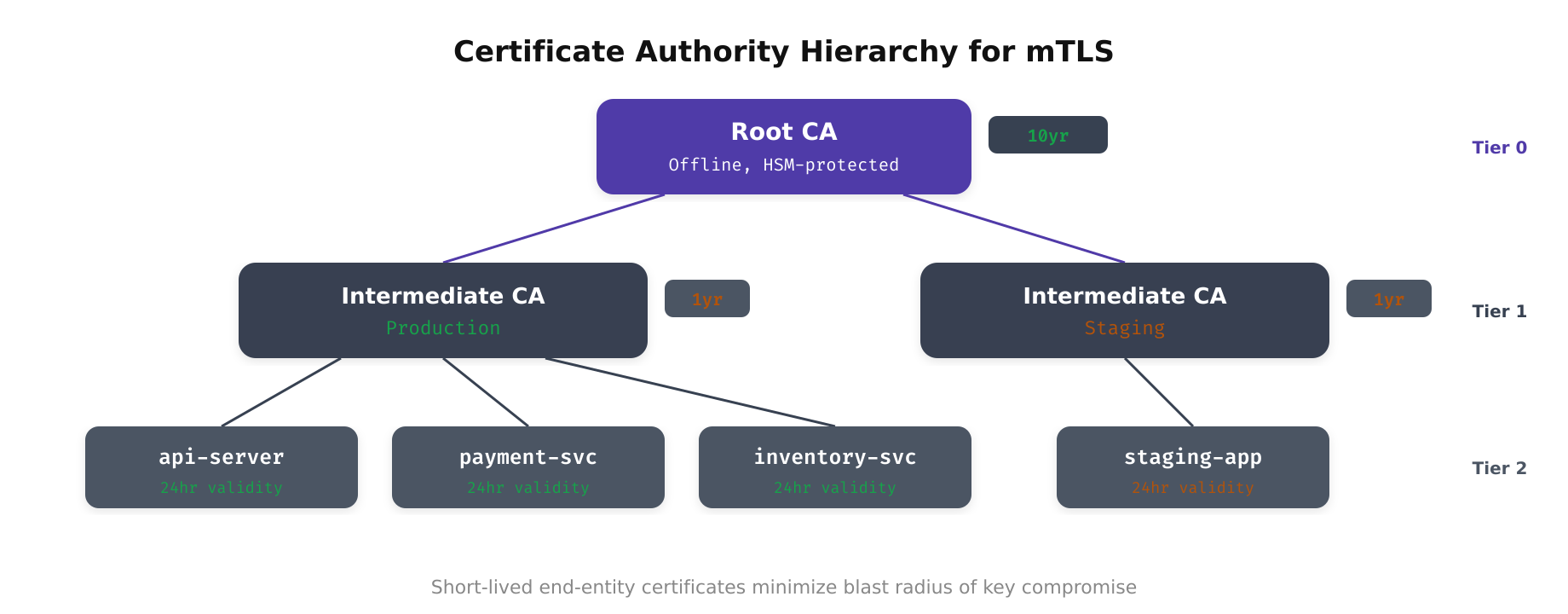
As shown above, the three-tier CA hierarchy separates trust anchoring from certificate issuance. The root CA remains offline and air-gapped, signing only intermediate CA certificates on a multi-year schedule. Intermediate CAs are scoped by environment or business unit, limiting the blast radius of any single CA compromise. Issuing CAs generate short-lived end-entity certificates for workloads, enabling automated rotation without manual intervention.
For Kubernetes-based workloads, a common architecture uses HashiCorp Vault as the issuing CA with cert-manager as the certificate lifecycle manager:
# Vault PKI setup for mTLS issuing CA
vault secrets enable -path=pki_int pki
vault secrets tune -max-lease-ttl=8760h pki_int

vault write pki_int/intermediate/generate/internal
    common_name="Production Issuing CA"
    key_type="ec"
    key_bits=256
    ttl=8760h

# Configure roles for service certificate issuance
vault write pki_int/roles/service-cert
    allowed_domains="svc.cluster.local"
    allow_subdomains=true
    max_ttl=24h
    key_type="ec"
    key_bits=256
    require_cn=false
    allowed_uri_sans="spiffe://cluster.local/*"
This configuration creates an issuing CA with a one-year lifetime that issues service certificates with a maximum 24-hour validity. Certificates use elliptic curve cryptography (P-256) for efficient key operations, and SPIFFE URIs are allowed as Subject Alternative Names (SANs) for workload identity integration.
Configuring mTLS in Real-World Services
Configuring mTLS correctly requires attention to both the server and client sides. Misconfigurations are the most common source of mTLS deployment failures, and they range from incorrect trust store configuration to certificate chain ordering issues.
Server-Side Configuration (Go)
Here is a Go HTTP server configured to require mTLS, demonstrating the essential configuration parameters:
package main

import (
    "crypto/tls"
    "crypto/x509"
    "log"
    "net/http"
    "os"
)

func main() {
    caCert, err := os.ReadFile("/etc/certs/ca-bundle.pem")
    if err != nil {
        log.Fatalf("Failed to read CA bundle: %v", err)
    }

    caCertPool := x509.NewCertPool()
    if !caCertPool.AppendCertsFromPEM(caCert) {
        log.Fatal("Failed to parse CA certificates")
    }

    tlsConfig := &tls.Config{
        ClientCAs:  caCertPool,
        ClientAuth: tls.RequireAndVerifyClientCert,
        MinVersion: tls.VersionTLS13,
        CurvePreferences: []tls.CurveID{
            tls.X25519,
            tls.CurveP256,
        },
    }

    server := &http.Server{
        Addr:      ":8443",
        TLSConfig: tlsConfig,
        Handler:   http.HandlerFunc(handler),
    }

    log.Fatal(server.ListenAndServeTLS(
        "/etc/certs/server.crt",
        "/etc/certs/server.key",
    ))
}

func handler(w http.ResponseWriter, r *http.Request) {
    // Extract client identity from verified certificate
    clientCert := r.TLS.PeerCertificates[0]
    log.Printf("Request from: %s (SAN: %v)",
        clientCert.Subject.CommonName,
        clientCert.URIs,
    )
    w.WriteHeader(http.StatusOK)
}
The critical setting is ClientAuth: tls.RequireAndVerifyClientCert. This ensures the server rejects any connection where the client does not present a valid certificate signed by a CA in the ClientCAs pool. The MinVersion: tls.VersionTLS13 setting enforces the latest TLS version, which provides improved security and performance.
Common Failure Modes and Debugging
mTLS deployments fail in predictable ways. Understanding these failure modes accelerates troubleshooting and prevents misdiagnosis of connection issues as application bugs.
- Certificate chain incomplete: The client or server presents its end-entity certificate without the intermediate CA certificate. The peer cannot build a chain to the root CA and rejects the connection. Always send the full chain: end-entity certificate followed by intermediate CA certificates.
- Trust store mismatch: The server’s ClientCAs pool does not include the CA that signed the client certificate, or vice versa. This commonly occurs when certificates are issued by different intermediate CAs. Verify trust stores include all relevant intermediate and root CA certificates.
- Certificate expired or not yet valid: Clock skew between services causes certificates to appear expired or not yet valid. NTP synchronization across all hosts is essential. Monitor clock drift and alert when it exceeds 1 second.
- SAN mismatch: The certificate’s Subject Alternative Names do not match the hostname or SPIFFE URI that the peer expects. Ensure certificates include all necessary DNS names and URIs in the SAN extension.
- Key algorithm incompatibility: Older clients may not support elliptic curve certificates. While EC certificates are preferred for performance, ensure all clients in the communication path support the chosen algorithm.
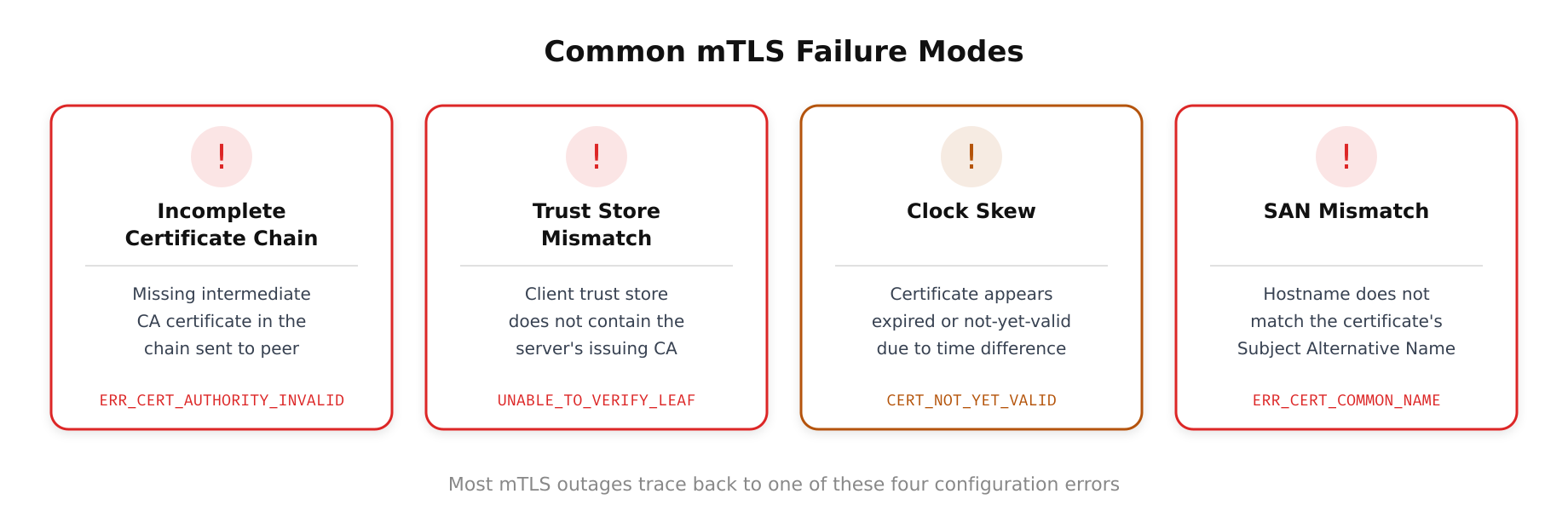
The above illustration depicts the most common mTLS failure scenarios that operations teams encounter in production. Each failure mode is traced from its root cause to the resulting TLS alert or error message, providing a visual troubleshooting reference. Expired certificates and CA trust store mismatches account for the majority of outages, underscoring the importance of automated certificate rotation and consistent trust store distribution across all services.
OpenSSL provides invaluable debugging tools for mTLS issues. The openssl s_client command can test mTLS connections with detailed handshake output:
openssl s_client -connect inventory-api:8443
    -cert /etc/certs/client.crt
    -key /etc/certs/client.key
    -CAfile /etc/certs/ca-bundle.pem
    -verify_return_error
    -status
Performance Considerations and Optimization
mTLS adds computational and latency overhead that must be accounted for in capacity planning. The primary costs are the asymmetric cryptographic operations during the handshake (key exchange and signature verification) and the certificate chain validation. For high-throughput services processing thousands of connections per second, these costs can become significant.
TLS session resumption significantly reduces the overhead of repeated connections between the same pair of services. TLS 1.3 supports session tickets that allow the handshake to complete in zero round trips (0-RTT) for resumed sessions, though 0-RTT data has replay risks and should not be used for non-idempotent operations. Connection pooling at the application level further reduces handshake frequency by reusing established connections across multiple requests.
Hardware acceleration through AES-NI instructions (available on virtually all modern x86 processors) offloads symmetric encryption to dedicated silicon, making the per-packet encryption cost negligible. For the asymmetric operations, elliptic curve cryptography (P-256 or X25519) is significantly faster than RSA, reducing handshake latency by an order of magnitude. In service mesh deployments, the sidecar proxy handles all cryptographic operations, so the application itself incurs zero TLS overhead.