
The scenario simulated here is TradeLink Maritime, a shipping consortium operating a Hyperledger Fabric 2.5 network across three data centers (London, Frankfurt, Singapore) with 3 organizations, 5 orderers, 6 peers, and 4 RPC gateways serving 200+ client applications processing bill of lading transactions.
Understanding Node Roles and Responsibilities
A production blockchain network is not a monolith. Each node type serves a specific function in the transaction lifecycle, and mixing roles on the same infrastructure creates resource contention that degrades performance under load. The four primary node types across both Fabric and Ethereum based networks are orderers (or validators), peers (or full nodes), certificate authorities, and RPC/gateway nodes.
In Hyperledger Fabric, orderer nodes manage the Raft consensus protocol and produce blocks. They never execute chaincode or store world state. Peer nodes execute chaincode during endorsement, maintain the full ledger, and serve queries. RPC gateway nodes act as client facing proxies, routing transactions to the correct endorsers and orderers based on the endorsement policy.
, Free to use, share it in your presentations, blogs, or learning materials.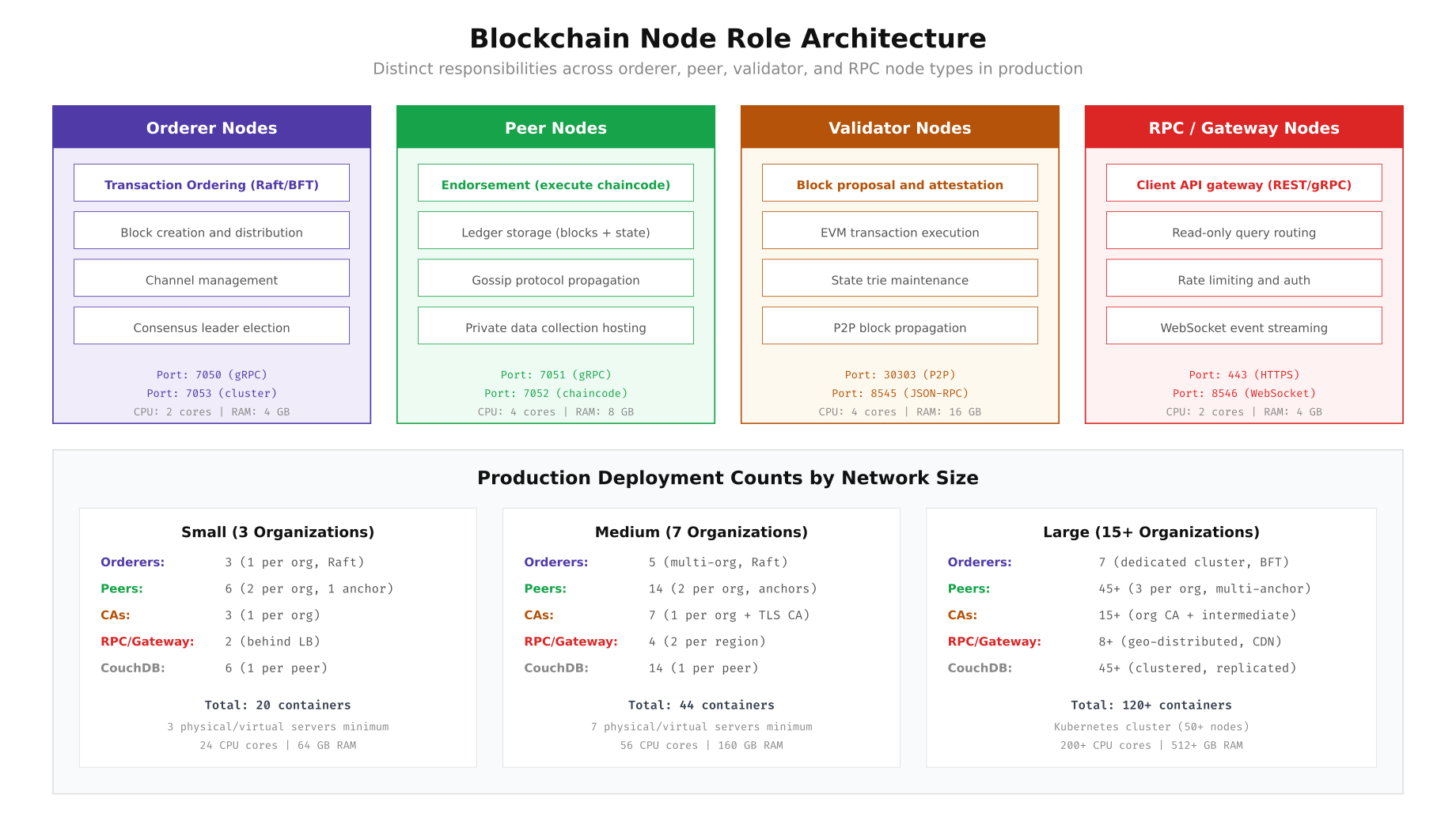
The above illustration maps out the four core node types and their distinct responsibilities. Orderer nodes handle transaction ordering via Raft consensus on ports 7050 and 7053, while peer nodes perform chaincode execution and ledger storage on ports 7051 and 7052. Validator nodes in Ethereum based networks manage block proposal and EVM execution, and RPC gateways provide the client facing API layer. The bottom section shows how deployment counts scale from 20 containers for a 3-org network to 120+ containers for large consortiums.
Orderer Node Configuration for Raft Consensus
TradeLink Maritime runs 5 Raft orderers distributed across three data centers. The orderer configuration in orderer.yaml controls consensus timeouts, batch sizes, and cluster communication. Start by generating the orderer genesis block and configuring each node.
# Generate orderer genesis block using configtxgen
configtxgen -profile TradeLink5OrgRaft \
  -channelID system-channel \
  -outputBlock /etc/hyperledger/fabric/genesis.block

# Orderer environment configuration (orderer0, London)
cat <<EOF > /etc/hyperledger/fabric/orderer.yaml
General:
  ListenAddress: 0.0.0.0
  ListenPort: 7050
  TLS:
    Enabled: true
    PrivateKey: /etc/hyperledger/fabric/tls/server.key
    Certificate: /etc/hyperledger/fabric/tls/server.crt
    RootCAs:
      - /etc/hyperledger/fabric/tls/ca.crt
    ClientAuthRequired: true
    ClientRootCAs:
      - /etc/hyperledger/fabric/tls/ca.crt
  Cluster:
    ListenAddress: 0.0.0.0
    ListenPort: 7053
    ServerCertificate: /etc/hyperledger/fabric/tls/server.crt
    ServerPrivateKey: /etc/hyperledger/fabric/tls/server.key
    ClientCertificate: /etc/hyperledger/fabric/tls/server.crt
    ClientPrivateKey: /etc/hyperledger/fabric/tls/server.key
    RootCAs:
      - /etc/hyperledger/fabric/tls/ca.crt
  BootstrapMethod: file
  BootstrapFile: /etc/hyperledger/fabric/genesis.block
  LocalMSPDir: /etc/hyperledger/fabric/msp
  LocalMSPID: OrdererMSP
  FileLedger:
    Location: /var/hyperledger/production/orderer
  MaxRecvMsgSize: 104857600
  MaxSendMsgSize: 104857600
  Keepalive:
    ServerMinInterval: 60s
    ServerInterval: 7200s
    ServerTimeout: 20s

Consensus:
  WALDir: /var/hyperledger/production/orderer/etcdraft/wal
  SnapDir: /var/hyperledger/production/orderer/etcdraft/snapshot
  TickInterval: 500ms
  ElectionTick: 10
  HeartbeatTick: 1
  MaxInflightBlocks: 5
  SnapshotIntervalSize: 20971520
EOF

# Start orderer process with resource limits
systemd-run --scope -p MemoryMax=8G -p CPUQuota=200% \
  orderer start 2>&1 | tee /var/log/orderer/orderer0.log
The Raft configuration uses a 500ms tick interval with an election timeout of 10 ticks (5 seconds). This balance works well for cross-datacenter deployments where London to Frankfurt latency averages 8ms and London to Singapore averages 170ms. The MaxInflightBlocks setting of 5 allows the leader to pipeline block distribution without overwhelming followers.
Peer Node Deployment with CouchDB State Database
Each organization in the TradeLink consortium runs two peers: one anchor peer that participates in cross-org gossip and one non-anchor peer for redundancy. The peer and CouchDB containers are colocated on the same host for low latency state queries.
# Peer core configuration (peer0.org1, London Rack A)
cat <<EOF > /etc/hyperledger/fabric/core.yaml
peer:
  id: peer0.org1.tradelink.net
  listenAddress: 0.0.0.0:7051
  chaincodeListenAddress: 0.0.0.0:7052
  address: peer0.org1.tradelink.net:7051
  addressAutoDetect: false
  networkId: tradelink-prod

  gossip:
    bootstrap: peer1.org1.tradelink.net:7051
    useLeaderElection: true
    orgLeader: false
    membershipTrackerInterval: 5s
    endpoint: peer0.org1.tradelink.net:7051
    externalEndpoint: peer0.org1.tradelink.net:7051
    maxBlockCountToStore: 100
    maxPropagationBurstLatency: 10ms
    maxPropagationBurstSize: 10
    propagateIterations: 1
    propagatePeerNum: 3
    pullInterval: 4s
    pullPeerNum: 3
    state:
      enabled: true
      checkInterval: 10s
      responseTimeout: 3s
      batchSize: 10
      blockBufferSize: 200
      maxRetries: 3

  tls:
    enabled: true
    clientAuthRequired: true
    cert:
      file: /etc/hyperledger/fabric/tls/server.crt
    key:
      file: /etc/hyperledger/fabric/tls/server.key
    rootcert:
      file: /etc/hyperledger/fabric/tls/ca.crt
    clientRootCAs:
      files:
        - /etc/hyperledger/fabric/tls/ca.crt

  localMspId: Org1MSP

ledger:
  state:
    stateDatabase: CouchDB
    couchDBConfig:
      couchDBAddress: localhost:5984
      username: admin
      password: \${COUCHDB_PASSWORD}
      maxRetries: 3
      maxRetriesOnStartup: 20
      requestTimeout: 35s
      createGlobalChangesDB: false
      cacheSize: 128

  history:
    enableHistoryDatabase: true

chaincode:
  builder: ccaas
  executetimeout: 30s

operations:
  listenAddress: 0.0.0.0:9443
  tls:
    enabled: true
    cert:
      file: /etc/hyperledger/fabric/tls/server.crt
    key:
      file: /etc/hyperledger/fabric/tls/server.key

metrics:
  provider: prometheus
EOF

# CouchDB configuration for the peer's state database
cat <<EOF > /opt/couchdb/etc/local.ini
[couchdb]
max_dbs_open = 500
os_process_timeout = 5000

[chttpd]
port = 5984
bind_address = 127.0.0.1
max_http_request_size = 67108864

[admins]
admin = \${COUCHDB_PASSWORD}

[log]
level = warning
file = /var/log/couchdb/couchdb.log

[compactions]
_default = [{db_fragmentation, "70%"}, {view_fragmentation, "60%"}]
EOF

# Start CouchDB then peer with health checks
systemctl start couchdb
until curl -sf http://127.0.0.1:5984/_up; do sleep 1; done
echo "CouchDB ready, starting peer..."
peer node start 2>&1 | tee /var/log/peer/peer0-org1.log
The gossip configuration deserves attention. Setting useLeaderElection: true with orgLeader: false enables dynamic leader election for the gossip protocol within each organization. The propagatePeerNum: 3 setting means each peer forwards received blocks to 3 other peers, creating rapid dissemination across the network. The CouchDB instance binds to localhost only, preventing external access to the state database.
Transaction Flow Through Node Types
Understanding how a transaction flows through different node types is essential for diagnosing latency bottlenecks and planning capacity. In Hyperledger Fabric, the execute-order-validate model separates transaction execution (endorsement by peers) from ordering (orderer consensus) and validation (committing peers). Each step involves different node types with different performance characteristics.
, Free to use, share it in your presentations, blogs, or learning materials.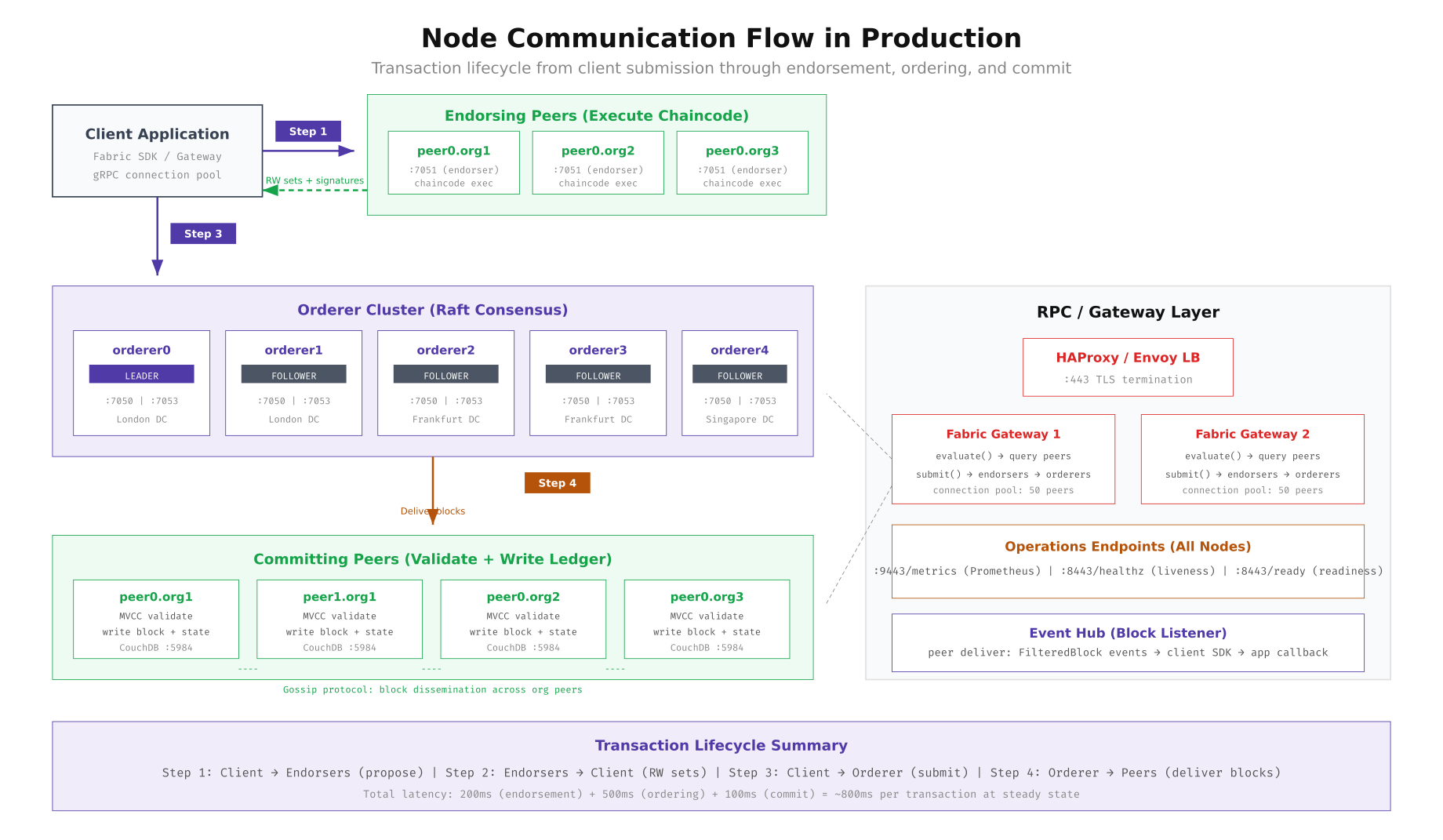
This diagram traces a transaction through all four steps. The client submits a proposal to endorsing peers (Step 1), receives signed read-write sets back (Step 2), forwards the endorsed transaction to the orderer cluster (Step 3), and then orderers deliver blocks to all committing peers (Step 4). The RPC gateway layer on the right shows how HAProxy or Envoy load balancers front the Fabric Gateway service, which internally manages connection pools to peers and orderers. Total steady state latency for this flow is approximately 800ms: 200ms for endorsement, 500ms for ordering, and 100ms for commit.
Fabric Gateway Service Configuration
The Fabric Gateway service (introduced in Fabric 2.4) simplifies client interaction by handling endorser selection and transaction submission internally. Deploy it as a separate service rather than embedding it in peer processes.
# Fabric Gateway connection profile for TradeLink
cat <<EOF > /etc/hyperledger/gateway/connection-tradelink.yaml
name: TradeLink Maritime Network
version: 1.0.0
client:
  organization: Org1
  connection:
    timeout:
      peer:
        endorser: 300
        eventHub: 300
        eventReg: 300
      orderer: 300

channels:
  shipping-channel:
    orderers:
      - orderer0.tradelink.net
      - orderer1.tradelink.net
      - orderer2.tradelink.net
    peers:
      peer0.org1.tradelink.net:
        endorsingPeer: true
        chaincodeQuery: true
        ledgerQuery: true
        eventSource: true
      peer0.org2.tradelink.net:
        endorsingPeer: true
        chaincodeQuery: true
        ledgerQuery: true
        eventSource: false
      peer0.org3.tradelink.net:
        endorsingPeer: true
        chaincodeQuery: false
        ledgerQuery: false
        eventSource: false

organizations:
  Org1:
    mspid: Org1MSP
    peers:
      - peer0.org1.tradelink.net
      - peer1.org1.tradelink.net
    certificateAuthorities:
      - ca.org1.tradelink.net

peers:
  peer0.org1.tradelink.net:
    url: grpcs://peer0.org1.tradelink.net:7051
    grpcOptions:
      ssl-target-name-override: peer0.org1.tradelink.net
      hostnameOverride: peer0.org1.tradelink.net
      grpc.keepalive_time_ms: 600000
      grpc.max_receive_message_length: 104857600
    tlsCACerts:
      path: /etc/hyperledger/fabric/tls/ca-org1.crt

orderers:
  orderer0.tradelink.net:
    url: grpcs://orderer0.tradelink.net:7050
    grpcOptions:
      ssl-target-name-override: orderer0.tradelink.net
      grpc.keepalive_time_ms: 600000
    tlsCACerts:
      path: /etc/hyperledger/fabric/tls/ca-orderer.crt
EOF

# HAProxy configuration for gateway load balancing
cat <<EOF > /etc/haproxy/haproxy.cfg
global
    maxconn 4096
    log /dev/log local0

defaults
    mode tcp
    timeout connect 5s
    timeout client 300s
    timeout server 300s
    option tcplog

frontend ft_gateway
    bind *:443 ssl crt /etc/haproxy/certs/gateway.pem
    default_backend bk_gateway

backend bk_gateway
    balance leastconn
    option httpchk GET /healthz
    http-check expect status 200
    server gw0 gateway-rpc-0:8443 check inter 3s fall 3 rise 2 ssl verify required ca-file /etc/haproxy/certs/ca.crt
    server gw1 gateway-rpc-1:8443 check inter 3s fall 3 rise 2 ssl verify required ca-file /etc/haproxy/certs/ca.crt
    server gw2 gateway-rpc-2:8443 check inter 3s fall 3 rise 2 ssl verify required ca-file /etc/haproxy/certs/ca.crt backup
    server gw3 gateway-rpc-3:8443 check inter 3s fall 3 rise 2 ssl verify required ca-file /etc/haproxy/certs/ca.crt backup

frontend ft_grpc_orderer
    bind *:7050 ssl crt /etc/haproxy/certs/orderer.pem
    default_backend bk_orderer

backend bk_orderer
    balance roundrobin
    server ord0 orderer0.tradelink.net:7050 check inter 5s ssl verify required ca-file /etc/haproxy/certs/ca-orderer.crt
    server ord1 orderer1.tradelink.net:7050 check inter 5s ssl verify required ca-file /etc/haproxy/certs/ca-orderer.crt
    server ord2 orderer2.tradelink.net:7050 check inter 5s ssl verify required ca-file /etc/haproxy/certs/ca-orderer.crt
EOF

systemctl restart haproxy
haproxy -c -f /etc/haproxy/haproxy.cfg && echo "HAProxy config valid"
Node Placement Strategy Across Data Centers
Placing nodes across racks and data centers requires balancing latency against fault tolerance. The key principle is that no single rack failure, power feed outage, or network partition should cause the network to lose consensus or the ability to process transactions. For TradeLink Maritime, orderers are spread across all three data centers, with London hosting the Raft leader under normal conditions.
, Free to use, share it in your presentations, blogs, or learning materials.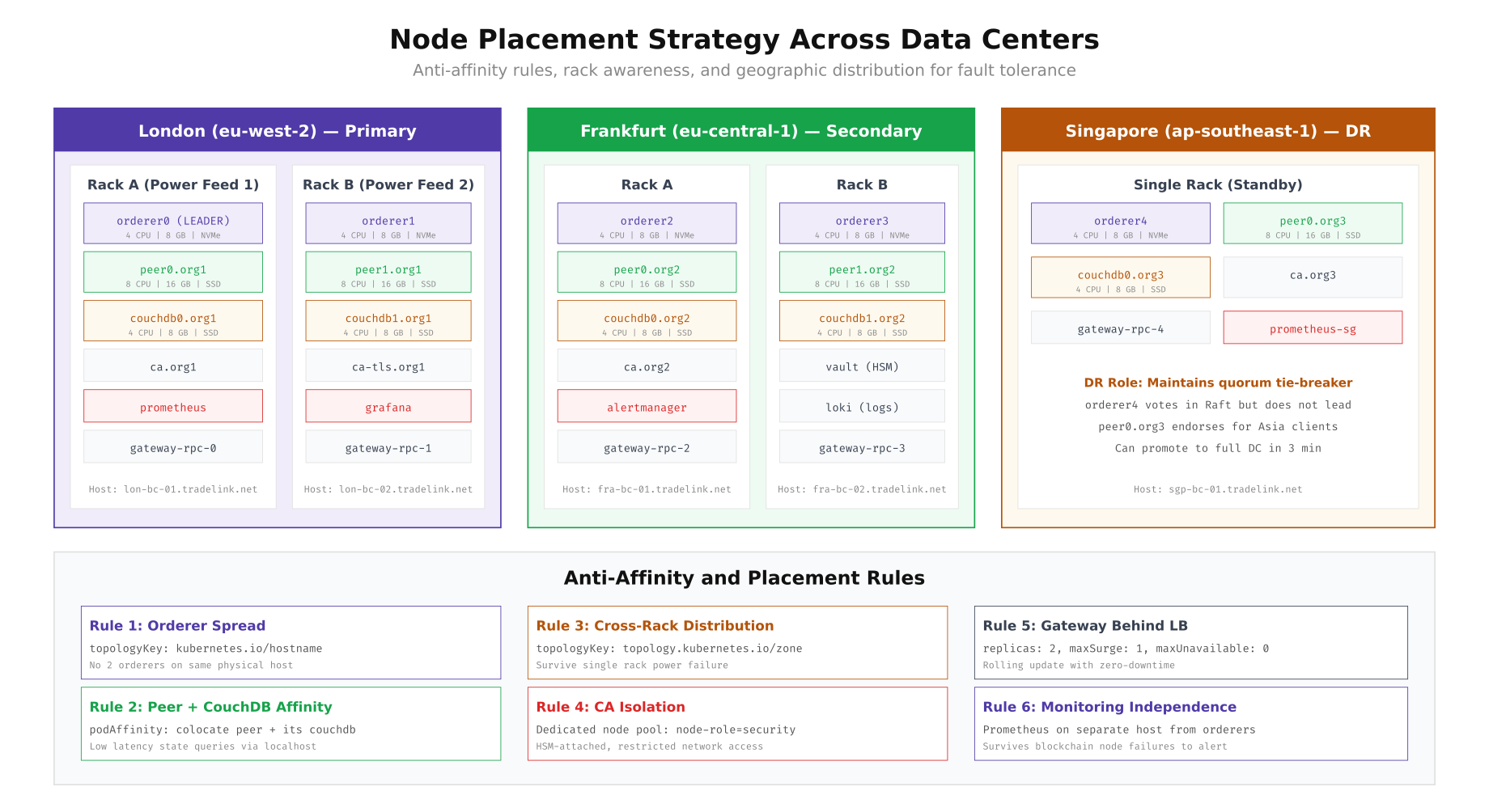
The layout above shows how TradeLink Maritime distributes nodes across London (primary, 2 racks), Frankfurt (secondary, 2 racks), and Singapore (DR, 1 rack). Each rack runs on a separate power feed, so a single power failure only impacts half the nodes in any given data center. The anti-affinity rules at the bottom enforce placement constraints: orderers never share a physical host, peer and CouchDB containers are colocated for performance, CAs run on dedicated HSM attached nodes, and monitoring systems remain on separate infrastructure to survive blockchain node failures.
Kubernetes Anti-Affinity Manifests
When deploying on Kubernetes, pod anti-affinity and node affinity rules enforce the placement strategy declaratively. The following manifests show the orderer StatefulSet with cross-zone spreading and the peer Deployment with CouchDB colocation.
# Orderer StatefulSet with anti-affinity (orderer-statefulset.yaml)
apiVersion: apps/v1
kind: StatefulSet
metadata:
  name: orderer
  namespace: fabric-orderers
spec:
  replicas: 5
  serviceName: orderer-cluster
  podManagementPolicy: Parallel
  selector:
    matchLabels:
      app: orderer
  template:
    metadata:
      labels:
        app: orderer
        network: tradelink
    spec:
      affinity:
        podAntiAffinity:
          requiredDuringSchedulingIgnoredDuringExecution:
            - labelSelector:
                matchExpressions:
                  - key: app
                    operator: In
                    values:
                      - orderer
              topologyKey: kubernetes.io/hostname
          preferredDuringSchedulingIgnoredDuringExecution:
            - weight: 100
              podAffinityTerm:
                labelSelector:
                  matchExpressions:
                    - key: app
                      operator: In
                      values:
                        - orderer
                topologyKey: topology.kubernetes.io/zone
        nodeAffinity:
          requiredDuringSchedulingIgnoredDuringExecution:
            nodeSelectorTerms:
              - matchExpressions:
                  - key: node-role
                    operator: In
                    values:
                      - blockchain
                  - key: storage-type
                    operator: In
                    values:
                      - nvme
      topologySpreadConstraints:
        - maxSkew: 1
          topologyKey: topology.kubernetes.io/zone
          whenUnsatisfiable: DoNotSchedule
          labelSelector:
            matchLabels:
              app: orderer
      containers:
        - name: orderer
          image: hyperledger/fabric-orderer:2.5.12
          ports:
            - containerPort: 7050
              name: grpc
            - containerPort: 7053
              name: cluster
            - containerPort: 9443
              name: metrics
          resources:
            requests:
              cpu: "2"
              memory: 4Gi
            limits:
              cpu: "4"
              memory: 8Gi
          volumeMounts:
            - name: orderer-data
              mountPath: /var/hyperledger/production
            - name: orderer-tls
              mountPath: /etc/hyperledger/fabric/tls
              readOnly: true
            - name: orderer-msp
              mountPath: /etc/hyperledger/fabric/msp
              readOnly: true
          livenessProbe:
            httpGet:
              path: /healthz
              port: 9443
              scheme: HTTPS
            initialDelaySeconds: 30
            periodSeconds: 10
          readinessProbe:
            httpGet:
              path: /healthz
              port: 9443
              scheme: HTTPS
            initialDelaySeconds: 10
            periodSeconds: 5
  volumeClaimTemplates:
    - metadata:
        name: orderer-data
      spec:
        accessModes: ["ReadWriteOnce"]
        storageClassName: nvme-fast
        resources:
          requests:
            storage: 100Gi

---
# Peer + CouchDB pod affinity (peer-deployment.yaml)
apiVersion: apps/v1
kind: StatefulSet
metadata:
  name: peer0-org1
  namespace: fabric-org1
spec:
  replicas: 1
  serviceName: peer0-org1
  selector:
    matchLabels:
      app: peer
      org: org1
      peer-id: peer0
  template:
    metadata:
      labels:
        app: peer
        org: org1
        peer-id: peer0
    spec:
      affinity:
        podAntiAffinity:
          requiredDuringSchedulingIgnoredDuringExecution:
            - labelSelector:
                matchExpressions:
                  - key: app
                    operator: In
                    values:
                      - peer
                  - key: org
                    operator: In
                    values:
                      - org1
              topologyKey: kubernetes.io/hostname
      containers:
        - name: peer
          image: hyperledger/fabric-peer:2.5.12
          ports:
            - containerPort: 7051
              name: grpc
            - containerPort: 7052
              name: chaincode
            - containerPort: 9443
              name: metrics
          resources:
            requests:
              cpu: "4"
              memory: 8Gi
            limits:
              cpu: "8"
              memory: 16Gi
          volumeMounts:
            - name: peer-data
              mountPath: /var/hyperledger/production
        - name: couchdb
          image: couchdb:3.3
          ports:
            - containerPort: 5984
          resources:
            requests:
              cpu: "2"
              memory: 4Gi
            limits:
              cpu: "4"
              memory: 8Gi
          env:
            - name: COUCHDB_USER
              value: admin
            - name: COUCHDB_PASSWORD
              valueFrom:
                secretKeyRef:
                  name: couchdb-secret
                  key: password
          volumeMounts:
            - name: couchdb-data
              mountPath: /opt/couchdb/data
  volumeClaimTemplates:
    - metadata:
        name: peer-data
      spec:
        accessModes: ["ReadWriteOnce"]
        storageClassName: ssd-retain
        resources:
          requests:
            storage: 200Gi
    - metadata:
        name: couchdb-data
      spec:
        accessModes: ["ReadWriteOnce"]
        storageClassName: ssd-retain
        resources:
          requests:
            storage: 100Gi
The orderer StatefulSet uses topologySpreadConstraints with maxSkew: 1 to ensure orderers distribute evenly across availability zones. The requiredDuringSchedulingIgnoredDuringExecution anti-affinity guarantees no two orderers land on the same physical host. For peers, the CouchDB sidecar container runs in the same pod, eliminating network latency for state queries while still maintaining separate persistent volume claims for independent scaling of block storage and state database storage.
Scaling Patterns for Each Node Type
Not all node types scale the same way. Peers can be added horizontally with minimal coordination. Orderers require careful Raft membership changes. RPC gateways scale freely behind load balancers. Understanding the constraints and triggers for each type prevents both over provisioning (wasted infrastructure cost) and under provisioning (degraded performance or consensus instability).
, Free to use, share it in your presentations, blogs, or learning materials.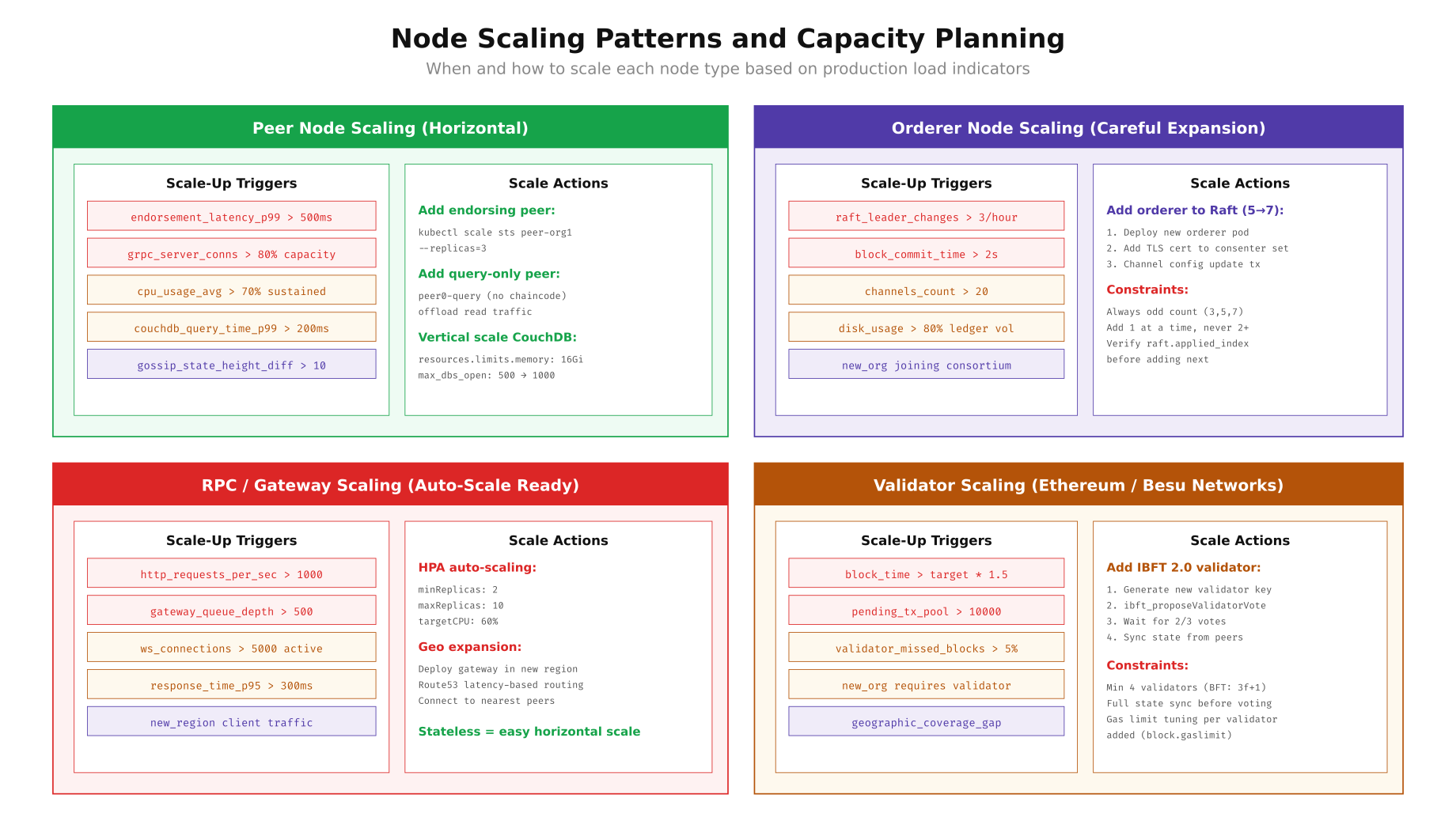
As shown above, each node type has different scaling triggers and constraints. Peers scale horizontally when endorsement latency exceeds 500ms or gRPC connections hit 80% capacity. Orderers scale carefully in odd numbers (3, 5, 7) with one at a time additions and Raft index verification between each. RPC gateways are stateless and can auto scale via Kubernetes HPA. Validators in Ethereum networks require a governance vote (2/3 majority in IBFT 2.0) before joining the validator set.
Adding a New Orderer to the Raft Cluster
When TradeLink Maritime needs to add a 6th orderer (for example, when a new partner organization in Dubai joins the consortium), the process involves deploying the new orderer, adding its TLS certificate to the consenter set, and then submitting a channel configuration update.
# Step 1: Deploy the new orderer node (orderer5 in Dubai)
kubectl apply -f orderer5-statefulset.yaml -n fabric-orderers

# Wait for the pod to be ready and synced
kubectl wait --for=condition=ready pod/orderer-5 -n fabric-orderers --timeout=120s

# Step 2: Fetch the current channel configuration
peer channel fetch config config_block.pb \
  -o orderer0.tradelink.net:7050 \
  -c shipping-channel \
  --tls --cafile /etc/hyperledger/fabric/tls/ca-orderer.crt

# Decode the config block
configtxlator proto_decode --input config_block.pb \
  --type common.Block --output config_block.json

# Extract the config
jq '.data.data[0].payload.data.config' config_block.json > config.json
cp config.json modified_config.json

# Step 3: Add new orderer to the consenter set
# Extract orderer5 TLS certificate (base64 encoded)
ORDERER5_TLS_CERT=$(base64 -w 0 /etc/hyperledger/fabric/tls/orderer5-server.crt)

# Add to consenters array using jq
jq '.channel_group.groups.Orderer.values.ConsensusType.value.metadata.consenters += [{
  "host": "orderer5.tradelink.net",
  "port": 7050,
  "client_tls_cert": "'$ORDERER5_TLS_CERT'",
  "server_tls_cert": "'$ORDERER5_TLS_CERT'"
}]' modified_config.json > modified_config_updated.json

# Also add to orderer addresses
jq '.channel_group.values.OrdererAddresses.value.addresses += [
  "orderer5.tradelink.net:7050"
]' modified_config_updated.json > modified_config_final.json

# Step 4: Compute the config update delta
configtxlator proto_encode --input config.json \
  --type common.Config --output config.pb
configtxlator proto_encode --input modified_config_final.json \
  --type common.Config --output modified_config.pb
configtxlator compute_update --channel_id shipping-channel \
  --original config.pb --updated modified_config.pb \
  --output config_update.pb

# Wrap in envelope
configtxlator proto_decode --input config_update.pb \
  --type common.ConfigUpdate --output config_update.json
echo '{"payload":{"header":{"channel_header":{"channel_id":"shipping-channel","type":2}},"data":{"config_update":'$(cat config_update.json)'}}}' | \
  jq . > config_update_envelope.json
configtxlator proto_encode --input config_update_envelope.json \
  --type common.Envelope --output config_update_envelope.pb

# Step 5: Collect signatures from majority of existing orderer orgs
peer channel signconfigtx -f config_update_envelope.pb

# Submit the update
peer channel update -f config_update_envelope.pb \
  -o orderer0.tradelink.net:7050 \
  -c shipping-channel \
  --tls --cafile /etc/hyperledger/fabric/tls/ca-orderer.crt

# Step 6: Verify the new orderer joined the cluster
peer channel fetch config verify_block.pb \
  -o orderer5.tradelink.net:7050 \
  -c shipping-channel \
  --tls --cafile /etc/hyperledger/fabric/tls/ca-orderer.crt

echo "Orderer5 successfully added to Raft cluster"

# Verify Raft cluster health (check applied index convergence)
for i in 0 1 2 3 4 5; do
  echo "orderer${i}:"
  curl -sk https://orderer${i}.tradelink.net:9443/metrics | \
    grep -E "etcdraft_cluster_size|consensus_etcdraft_applied_index"
done
After adding the orderer, always verify that the consensus_etcdraft_applied_index converges across all nodes. A lagging applied index on the new orderer means it is still catching up with the block history, and you should not add another orderer until convergence is complete. The cluster size metric should report 6 across all nodes after the configuration update takes effect.
Horizontal Peer Scaling and Query Offloading
When Org1’s peers hit capacity during peak bill of lading processing, add a query-only peer that does not participate in endorsement. This offloads read queries from the endorsing peers while maintaining the full ledger for audit purposes.
# Scale the peer StatefulSet to add a third peer
kubectl scale sts peer0-org1 --replicas=3 -n fabric-org1

# Alternatively, deploy a dedicated query peer
cat <<EOF | kubectl apply -f -
apiVersion: apps/v1
kind: StatefulSet
metadata:
  name: peer-query-org1
  namespace: fabric-org1
spec:
  replicas: 1
  serviceName: peer-query-org1
  selector:
    matchLabels:
      app: peer-query
      org: org1
  template:
    metadata:
      labels:
        app: peer-query
        org: org1
    spec:
      containers:
        - name: peer
          image: hyperledger/fabric-peer:2.5.12
          env:
            - name: CORE_PEER_ID
              value: peer-query.org1.tradelink.net
            - name: CORE_PEER_GOSSIP_USELEADERELECTION
              value: "false"
            - name: CORE_PEER_GOSSIP_ORGLEADER
              value: "false"
            - name: CORE_PEER_GOSSIP_BOOTSTRAP
              value: peer0-org1-0.peer0-org1.fabric-org1:7051
            - name: CORE_PEER_CHAINCODEADDRESS
              value: ""
          resources:
            requests:
              cpu: "2"
              memory: 4Gi
            limits:
              cpu: "4"
              memory: 8Gi
          ports:
            - containerPort: 7051
              name: grpc
        - name: couchdb
          image: couchdb:3.3
          resources:
            requests:
              cpu: "1"
              memory: 2Gi
EOF

# Configure HAProxy to route read-only queries to the query peer
cat <<EOF >> /etc/haproxy/haproxy.cfg
backend bk_peer_query_org1
    balance roundrobin
    option httpchk GET /healthz
    http-check expect status 200
    server peer0 peer0-org1-0.fabric-org1:7051 check ssl
    server peer1 peer0-org1-1.fabric-org1:7051 check ssl
    server peer-query peer-query-org1-0.fabric-org1:7051 check ssl
EOF

# Verify the query peer synced the ledger
kubectl exec -it peer-query-org1-0 -n fabric-org1 -- \
  peer channel getinfo -c shipping-channel

# Compare block height with endorsing peers
for peer in peer0-org1-0 peer0-org1-1 peer-query-org1-0; do
  echo "${peer}:"
  kubectl exec -it ${peer} -n fabric-org1 -- \
    peer channel getinfo -c shipping-channel 2>&1 | grep "Blockchain info"
done
Validator and RPC Node Topology for Ethereum Networks
For organizations running Besu or Geth based networks, the topology differs from Fabric. Validator nodes replace orderers as the consensus participants, and RPC nodes serve as the public interface. TradeLink’s subsidiary running a Besu IBFT 2.0 network for port authority document verification uses the following topology.
# Besu validator node configuration (validator1, Frankfurt)
cat <<EOF > /etc/besu/config.toml
data-path="/var/lib/besu/data"
genesis-file="/etc/besu/genesis.json"

# Network
p2p-enabled=true
p2p-host="0.0.0.0"
p2p-port=30303
discovery-enabled=false
bootnodes=[
  "enode://abc123...@validator0.tradelink.net:30303",
  "enode://def456...@validator2.tradelink.net:30303",
  "enode://ghi789...@validator3.tradelink.net:30303"
]

# RPC (disabled on validators for security)
rpc-http-enabled=false
rpc-ws-enabled=false
graphql-http-enabled=false

# Metrics
metrics-enabled=true
metrics-host="0.0.0.0"
metrics-port=9545
metrics-protocol="PROMETHEUS"

# Mining / Validator
miner-enabled=true
miner-coinbase="0x1234567890abcdef1234567890abcdef12345678"

# Performance
tx-pool-max-size=4096
tx-pool-retention-hours=999
Xplugin-rocksdb-max-open-files=1024
EOF

# Besu RPC node configuration (rpc-node1, public facing)
cat <<EOF > /etc/besu/rpc-config.toml
data-path="/var/lib/besu/rpc-data"
genesis-file="/etc/besu/genesis.json"
sync-mode="SNAP"

# Network
p2p-enabled=true
p2p-host="0.0.0.0"
p2p-port=30303

# RPC (enabled on RPC nodes)
rpc-http-enabled=true
rpc-http-host="0.0.0.0"
rpc-http-port=8545
rpc-http-cors-origins=["*"]
rpc-http-api=["ETH","NET","WEB3","TXPOOL"]
rpc-http-max-active-connections=200
rpc-http-max-batch-size=50

rpc-ws-enabled=true
rpc-ws-host="0.0.0.0"
rpc-ws-port=8546
rpc-ws-api=["ETH","NET","WEB3"]
rpc-ws-max-active-connections=500

# Do NOT enable admin, debug, miner APIs on public RPC
# rpc-http-api=["ADMIN","DEBUG","MINER"]  # NEVER on public nodes

# Metrics
metrics-enabled=true
metrics-host="0.0.0.0"
metrics-port=9545

# NOT a validator
miner-enabled=false
EOF

# NGINX rate limiting for RPC nodes
cat <<EOF > /etc/nginx/conf.d/besu-rpc.conf
limit_req_zone \$binary_remote_addr zone=rpc_limit:10m rate=50r/s;
limit_conn_zone \$binary_remote_addr zone=rpc_conn:10m;

upstream besu_rpc {
    least_conn;
    server rpc-node0.tradelink.net:8545 max_fails=3 fail_timeout=10s;
    server rpc-node1.tradelink.net:8545 max_fails=3 fail_timeout=10s;
    server rpc-node2.tradelink.net:8545 max_fails=3 fail_timeout=10s backup;
}

server {
    listen 443 ssl;
    server_name rpc.tradelink.net;

    ssl_certificate /etc/nginx/certs/rpc.crt;
    ssl_certificate_key /etc/nginx/certs/rpc.key;
    ssl_protocols TLSv1.3;

    location /rpc {
        limit_req zone=rpc_limit burst=100 nodelay;
        limit_conn rpc_conn 20;

        proxy_pass http://besu_rpc;
        proxy_set_header X-Real-IP \$remote_addr;
        proxy_http_version 1.1;
        proxy_set_header Upgrade \$http_upgrade;
        proxy_set_header Connection "upgrade";
        proxy_read_timeout 300s;
    }
}
EOF

nginx -t && systemctl reload nginx
The critical security distinction is that validator nodes have all RPC interfaces disabled. They communicate only via P2P (port 30303) and expose Prometheus metrics (port 9545) to the internal monitoring network. The RPC nodes expose HTTP and WebSocket APIs but explicitly exclude admin, debug, and miner API namespaces. NGINX provides rate limiting at 50 requests per second per client IP with a burst buffer of 100, protecting the RPC nodes from overload.
Monitoring Node Health Across the Topology
With nodes distributed across data centers and roles, monitoring must cover both individual node health and cross-node relationships (Raft leader election, gossip state height, endorsement latency). Set up Prometheus scrape targets for each node type and create role-specific dashboards.
# Prometheus scrape configuration for all node types
cat <<EOF > /etc/prometheus/scrape-blockchain.yml
scrape_configs:
  - job_name: fabric-orderers
    scheme: https
    tls_config:
      ca_file: /etc/prometheus/certs/ca-orderer.crt
      cert_file: /etc/prometheus/certs/prometheus.crt
      key_file: /etc/prometheus/certs/prometheus.key
    static_configs:
      - targets:
          - orderer0.tradelink.net:9443
          - orderer1.tradelink.net:9443
          - orderer2.tradelink.net:9443
          - orderer3.tradelink.net:9443
          - orderer4.tradelink.net:9443
        labels:
          role: orderer
          network: tradelink

  - job_name: fabric-peers
    scheme: https
    tls_config:
      ca_file: /etc/prometheus/certs/ca-peer.crt
    static_configs:
      - targets:
          - peer0.org1.tradelink.net:9443
          - peer1.org1.tradelink.net:9443
          - peer0.org2.tradelink.net:9443
          - peer1.org2.tradelink.net:9443
          - peer0.org3.tradelink.net:9443
        labels:
          role: peer
          network: tradelink

  - job_name: fabric-gateways
    scheme: https
    static_configs:
      - targets:
          - gateway-rpc-0.tradelink.net:9443
          - gateway-rpc-1.tradelink.net:9443
          - gateway-rpc-2.tradelink.net:9443
          - gateway-rpc-3.tradelink.net:9443
        labels:
          role: gateway
          network: tradelink

  - job_name: couchdb
    scheme: http
    metrics_path: /_node/_local/_prometheus
    static_configs:
      - targets:
          - couchdb0-org1.tradelink.net:5984
          - couchdb1-org1.tradelink.net:5984
          - couchdb0-org2.tradelink.net:5984
          - couchdb1-org2.tradelink.net:5984
          - couchdb0-org3.tradelink.net:5984
        labels:
          role: statedb
EOF

# Alert rules specific to node topology
cat <<EOF > /etc/prometheus/rules/node-topology-alerts.yml
groups:
  - name: orderer_topology
    rules:
      - alert: RaftLeaderLost
        expr: max(consensus_etcdraft_is_leader{job="fabric-orderers"}) == 0
        for: 10s
        labels:
          severity: critical
        annotations:
          summary: "No Raft leader elected in TradeLink orderer cluster"

      - alert: OrdrerClusterDegraded
        expr: count(up{job="fabric-orderers"} == 1) < 3
        for: 30s
        labels:
          severity: critical
        annotations:
          summary: "Orderer cluster below quorum threshold ({{ \$value }}/5)"

      - alert: PeerLedgerLag
        expr: |
          max(ledger_blockchain_height{job="fabric-peers"})
          - min(ledger_blockchain_height{job="fabric-peers"}) > 10
        for: 2m
        labels:
          severity: warning
        annotations:
          summary: "Peer ledger height divergence > 10 blocks"

      - alert: GatewayHighLatency
        expr: |
          histogram_quantile(0.99,
            rate(grpc_server_handling_seconds_bucket{job="fabric-gateways"}[5m])
          ) > 2
        for: 5m
        labels:
          severity: warning
        annotations:
          summary: "Gateway P99 latency > 2s"

      - alert: CouchDBHighRequestTime
        expr: |
          rate(couchdb_httpd_request_time_sum[5m])
          / rate(couchdb_httpd_request_time_count[5m]) > 0.2
        for: 5m
        labels:
          severity: warning
        annotations:
          summary: "CouchDB average request time > 200ms"
EOF

# Verify alert rules syntax
promtool check rules /etc/prometheus/rules/node-topology-alerts.yml
systemctl reload prometheus
The alert rules target specific topology concerns: Raft leader loss (no ordering possible), cluster degradation below quorum threshold, peer ledger height divergence (gossip issues), gateway latency spikes, and CouchDB performance degradation. Each alert has a carefully tuned for duration to avoid false positives while catching genuine issues quickly. The CouchDB metric endpoint at /_node/_local/_prometheus requires CouchDB 3.3+ and provides detailed database operation metrics.
Network Segmentation for Node Security
Each node type should operate within its own network segment, with firewall rules controlling inter-segment communication. Orderers talk to each other (Raft cluster port 7053) and to peers (block delivery port 7050). Peers talk to other peers (gossip) and to CouchDB (localhost only). RPC gateways need access to peers and orderers but should be isolated from direct CouchDB access.
# Kubernetes NetworkPolicy for node segmentation
---
# Allow orderer-to-orderer Raft communication
apiVersion: networking.k8s.io/v1
kind: NetworkPolicy
metadata:
  name: orderer-cluster-policy
  namespace: fabric-orderers
spec:
  podSelector:
    matchLabels:
      app: orderer
  policyTypes:
    - Ingress
    - Egress
  ingress:
    # Raft cluster communication (orderer-to-orderer)
    - from:
        - podSelector:
            matchLabels:
              app: orderer
      ports:
        - port: 7053
          protocol: TCP
    # Block delivery to peers
    - from:
        - namespaceSelector:
            matchLabels:
              network: tradelink
          podSelector:
            matchLabels:
              app: peer
      ports:
        - port: 7050
          protocol: TCP
    # Gateway transaction submission
    - from:
        - namespaceSelector:
            matchLabels:
              network: tradelink
          podSelector:
            matchLabels:
              app: gateway
      ports:
        - port: 7050
          protocol: TCP
    # Prometheus scraping
    - from:
        - namespaceSelector:
            matchLabels:
              purpose: monitoring
      ports:
        - port: 9443
          protocol: TCP
  egress:
    - to:
        - podSelector:
            matchLabels:
              app: orderer
      ports:
        - port: 7053
          protocol: TCP
    - to:
        - namespaceSelector: {}
      ports:
        - port: 53
          protocol: UDP
        - port: 53
          protocol: TCP
---
# Peer network policy
apiVersion: networking.k8s.io/v1
kind: NetworkPolicy
metadata:
  name: peer-network-policy
  namespace: fabric-org1
spec:
  podSelector:
    matchLabels:
      app: peer
  policyTypes:
    - Ingress
    - Egress
  ingress:
    # Gossip from other peers in same org
    - from:
        - podSelector:
            matchLabels:
              app: peer
              org: org1
      ports:
        - port: 7051
          protocol: TCP
    # Cross-org gossip (anchor peers only)
    - from:
        - namespaceSelector:
            matchLabels:
              network: tradelink
          podSelector:
            matchLabels:
              app: peer
      ports:
        - port: 7051
          protocol: TCP
    # Gateway queries and endorsement
    - from:
        - namespaceSelector:
            matchLabels:
              network: tradelink
          podSelector:
            matchLabels:
              app: gateway
      ports:
        - port: 7051
          protocol: TCP
    # Chaincode execution
    - from:
        - podSelector:
            matchLabels:
              app: chaincode
      ports:
        - port: 7052
          protocol: TCP
  egress:
    # Connect to orderers for block delivery
    - to:
        - namespaceSelector:
            matchLabels:
              purpose: ordering
      ports:
        - port: 7050
          protocol: TCP
    # CouchDB (same pod, localhost)
    - to:
        - podSelector:
            matchLabels:
              app: peer
      ports:
        - port: 5984
          protocol: TCP
    # DNS
    - to:
        - namespaceSelector: {}
      ports:
        - port: 53
          protocol: UDP
EOF

# Apply all policies
kubectl apply -f orderer-cluster-policy.yaml
kubectl apply -f peer-network-policy.yaml

# Verify policies are active
kubectl get networkpolicies -A | grep -E "orderer|peer"
These NetworkPolicies implement the principle of least privilege at the network layer. Each node type can only communicate with the specific ports and node types it requires. The orderer cluster policy allows Raft communication on port 7053 only between orderer pods, block delivery on port 7050 only from peer and gateway namespaces, and Prometheus scraping from the monitoring namespace. Peer policies restrict CouchDB access to the same pod (localhost), gossip to labeled peer pods, and orderer access only for block delivery.
Capacity Planning and Resource Allocation
Each node type has different resource consumption patterns. Orderers are CPU bound during high transaction throughput. Peers are memory bound due to chaincode execution and CouchDB caching. RPC gateways are network I/O bound with high connection counts. Plan resource allocation based on measured baselines, not assumptions.
# Benchmark script: measure actual resource usage per node type
#!/bin/bash
# capacity-audit.sh - Run on each blockchain host

NODE_TYPE="${1:-peer}"
DURATION=300  # 5 minute sample

echo "=== Capacity Audit: ${NODE_TYPE} ==="
echo "Host: $(hostname)"
echo "Timestamp: $(date -u +%Y-%m-%dT%H:%M:%SZ)"
echo ""

# CPU usage (per core average over sample period)
echo "--- CPU Usage ---"
mpstat -P ALL 10 $((DURATION/10)) | tail -n +4

# Memory usage breakdown
echo ""
echo "--- Memory Usage ---"
free -h
echo ""
cat /proc/meminfo | grep -E "MemTotal|MemFree|Buffers|Cached|SwapTotal|SwapFree"

# Disk I/O for blockchain volumes
echo ""
echo "--- Disk I/O (blockchain volumes) ---"
iostat -xdh /dev/nvme0n1 10 $((DURATION/10)) 2>/dev/null || \
  iostat -xdh 10 $((DURATION/10))

# Network connections by port
echo ""
echo "--- Network Connections ---"
ss -s
echo ""
echo "Port breakdown:"
ss -tlnp | grep -E "7050|7051|7052|7053|5984|8545|9443"

# Process-specific resource usage
echo ""
echo "--- Process Resources ---"
case $NODE_TYPE in
  orderer)
    ps aux | head -1
    ps aux | grep "[o]rderer"
    echo ""
    # Raft WAL directory size
    echo "WAL size: $(du -sh /var/hyperledger/production/orderer/etcdraft/wal 2>/dev/null)"
    echo "Snap size: $(du -sh /var/hyperledger/production/orderer/etcdraft/snapshot 2>/dev/null)"
    echo "Ledger size: $(du -sh /var/hyperledger/production/orderer 2>/dev/null)"
    ;;
  peer)
    ps aux | head -1
    ps aux | grep -E "[p]eer|[c]ouchdb"
    echo ""
    echo "Ledger size: $(du -sh /var/hyperledger/production 2>/dev/null)"
    echo "CouchDB size: $(du -sh /opt/couchdb/data 2>/dev/null)"
    # CouchDB connection count
    curl -s http://127.0.0.1:5984/_node/_local/_stats/couchdb/open_databases 2>/dev/null
    ;;
  gateway)
    ps aux | head -1
    ps aux | grep -E "[g]ateway|[h]aproxy|[e]nvoy"
    echo ""
    echo "Active gRPC connections:"
    ss -tnp | grep -c ":7051"
    echo "Active client connections:"
    ss -tnp | grep -c ":443"
    ;;
esac

echo ""
echo "=== Audit Complete ==="
Run this audit script on each node type during peak load to establish baselines. For TradeLink Maritime processing 500 transactions per second across the shipping channel, typical resource consumption is: orderers at 40% CPU and 3.2 GB RAM, peers at 65% CPU and 12 GB RAM (with chaincode execution), CouchDB at 30% CPU and 6 GB RAM (heavily cached), and gateway nodes at 15% CPU and 2 GB RAM but with 800+ active gRPC connections. These baselines inform the Kubernetes resource requests and limits in the StatefulSet manifests, ensuring pods are neither starved of resources nor wastefully over provisioned.
Summary
Designing node topology for production blockchain networks requires understanding the distinct responsibilities and scaling characteristics of each node type. Orderer nodes manage consensus and must be distributed carefully in odd numbers across fault domains. Peer nodes handle endorsement and ledger storage, scaling horizontally with query offload patterns. RPC gateways provide the stateless client interface and scale freely behind load balancers. Validator nodes in Ethereum networks combine consensus and execution, requiring dedicated resources and governance based onboarding.
TradeLink Maritime’s deployment demonstrates a proven topology: 5 Raft orderers across 3 data centers, 6 peers with colocated CouchDB instances, 4 gateway nodes behind HAProxy, and comprehensive Kubernetes anti-affinity rules that survive rack, power feed, and full data center failures. Combined with proper network segmentation via NetworkPolicies and role-specific monitoring alerts, this topology delivers the reliability needed for a production shipping consortium processing hundreds of transactions per second.