
Customer Support
Free to use, share it in your presentations, blogs, or learning materials.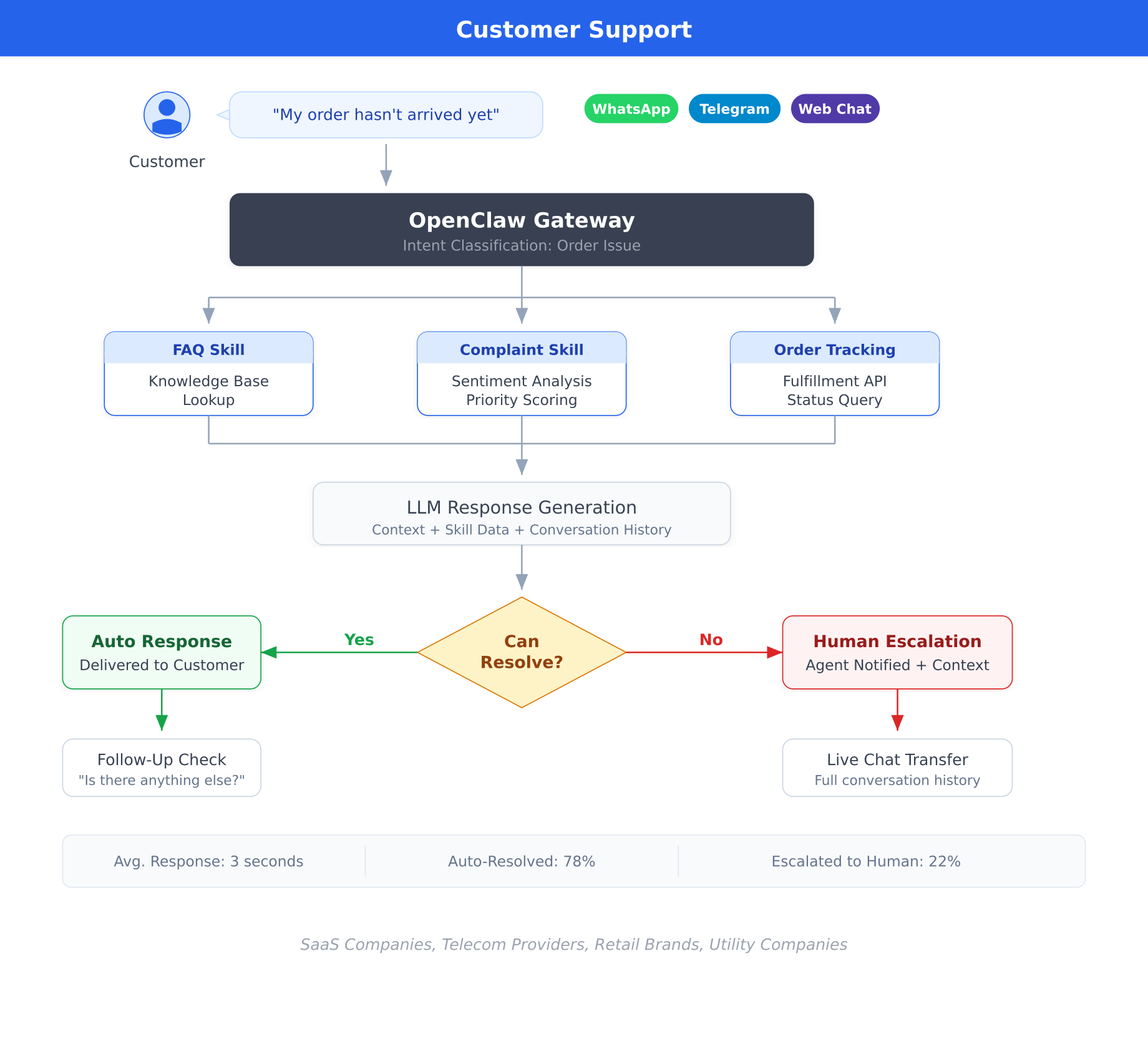
The diagram above traces how a customer message like “My order hasn’t arrived yet” flows through the OpenClaw gateway. The gateway classifies the intent and routes it to one of three skills: FAQ resolution for common questions, complaint handling with sentiment analysis and priority scoring, or order tracking through a fulfillment API. After the matched skill retrieves the relevant data, the LLM generates a contextual response. A decision gate determines whether the issue can be auto-resolved or requires human escalation, with full conversation history transferred to the live agent when needed. SaaS companies, telecom providers, and retail brands using this approach report auto-resolution rates above 75% with average response times under 3 seconds.
Without OpenClaw
- Customers wait in queues during peak hours, with average hold times exceeding 10 minutes
- Agents manually search knowledge bases and copy-paste answers, leading to inconsistent responses
- After-hours inquiries go unanswered until the next business day, causing ticket backlogs every morning
- Scaling support requires hiring and training more agents, which takes weeks per new hire
With OpenClaw
- Instant responses around the clock with sub-3-second reply times across all channels
- Skill-based routing ensures every query hits the right knowledge domain on the first attempt
- Over 75% of tickets auto-resolved without human involvement, freeing agents for complex cases
- New support topics added by creating a skill file, no retraining or additional headcount needed
Healthcare
Free to use, share it in your presentations, blogs, or learning materials.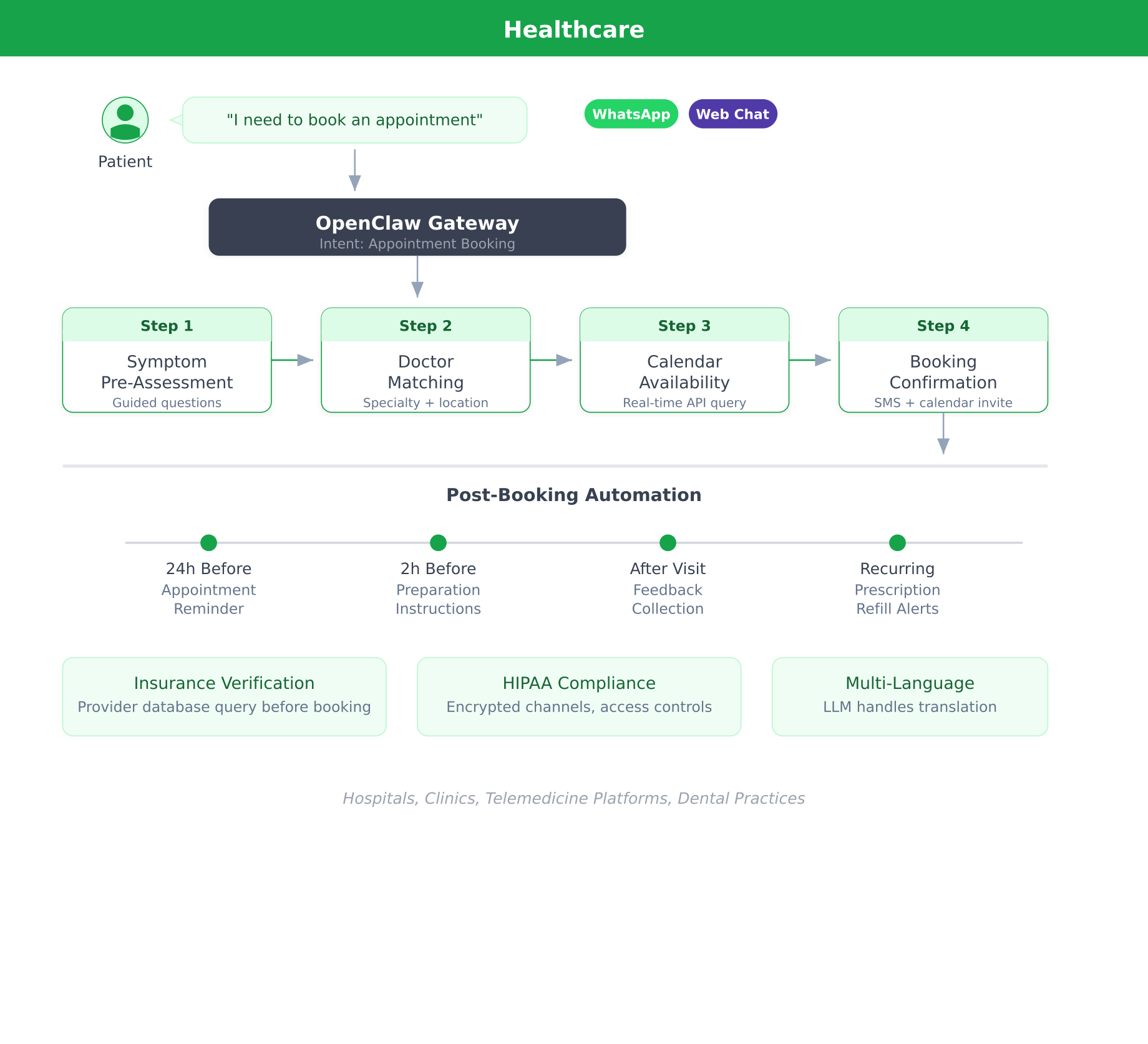
This flow illustrates how a patient requesting an appointment moves through a four-stage pipeline: symptom pre-assessment through guided questions, doctor matching based on specialty and location, real-time calendar availability checks via API, and booking confirmation with SMS and calendar invite delivery. The post-booking automation timeline shows the system sending appointment reminders 24 hours before, preparation instructions 2 hours before, feedback collection after the visit, and recurring prescription refill alerts. All patient data flows through encrypted channels with HIPAA-compliant access controls configured at the gateway level. Insurance verification runs as a parallel check before the booking is confirmed.
Without OpenClaw
- Patients call during office hours only, often waiting on hold while staff manually check doctor calendars
- No-show rates climb because reminder calls depend on overworked front desk staff
- Symptom information collected verbally gets lost or recorded inconsistently across intake forms
- Post-visit follow-ups like prescription refills and feedback collection fall through the cracks
With OpenClaw
- Patients book appointments at any hour through WhatsApp or web chat with real-time calendar visibility
- Automated reminder and preparation messages reduce no-show rates significantly
- Structured symptom pre-assessment ensures doctors receive consistent patient context before the visit
- Insurance verification, feedback collection, and refill alerts run automatically on schedule
Banking and Finance
Free to use, share it in your presentations, blogs, or learning materials.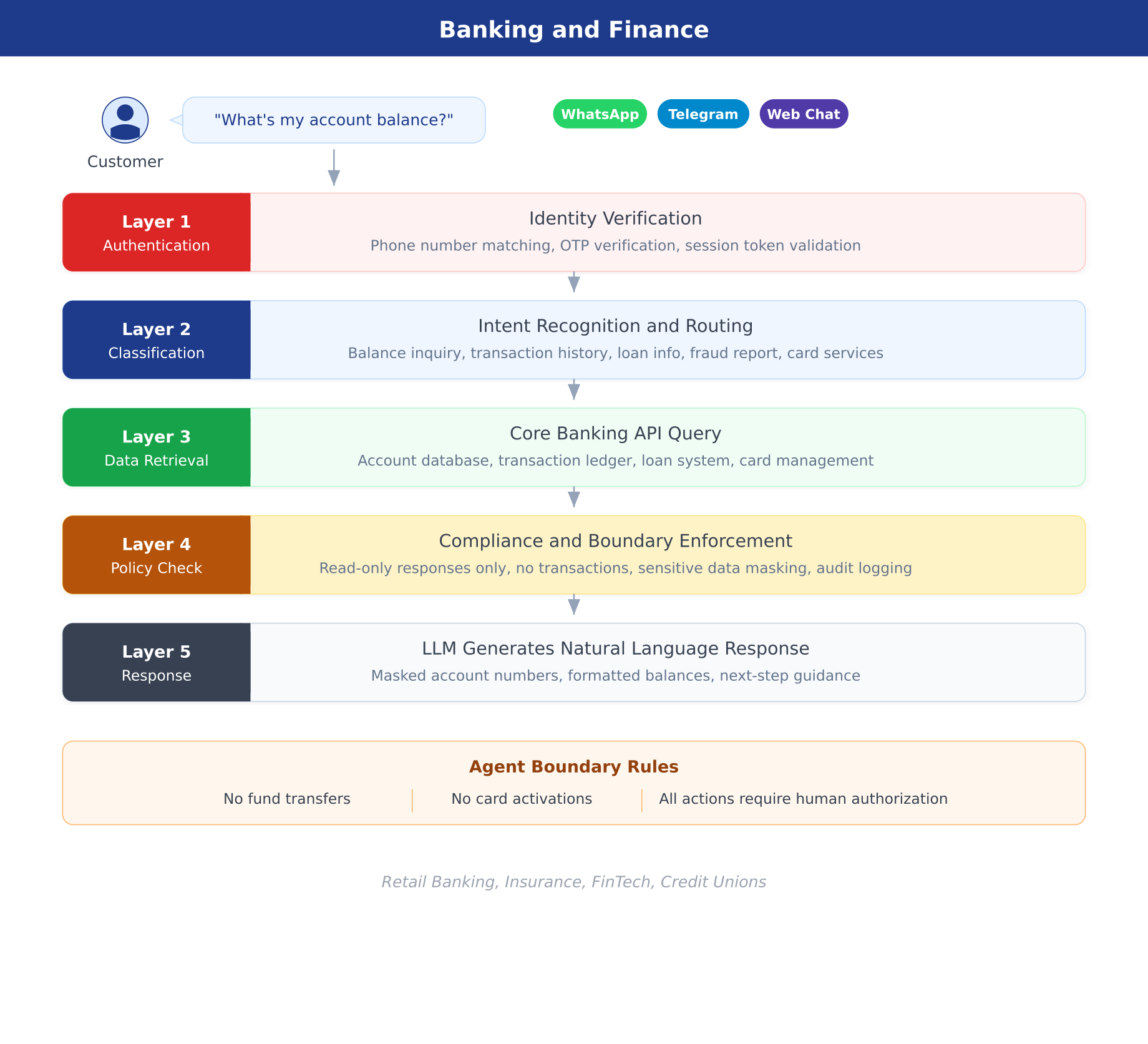
Banking requires a fundamentally different architecture than other industries because every interaction passes through multiple security layers before a response is generated. The diagram shows five sequential layers: authentication (phone number matching, OTP verification, session token validation), intent classification (routing to balance, transaction, loan, or fraud skills), core banking API query (account database and transaction ledger lookups), policy enforcement (read-only responses, sensitive data masking, audit logging), and finally the LLM response with masked account numbers and formatted balances. The boundary rules at the bottom are critical: the agent cannot perform fund transfers, activate cards, or take any financial action without explicit human authorization through the bank’s secure portal.
Without OpenClaw
- Customers navigate IVR menus for minutes before reaching a human who can check their balance or transaction history
- Branch visits for simple inquiries clog physical locations and consume staff time on repetitive lookups
- Fraud alerts rely on delayed email or SMS notifications with no conversational follow-up
- Every new channel (mobile app, WhatsApp) requires a separate integration project with its own security review
With OpenClaw
- Balance checks, transaction lookups, and loan inquiries answered instantly through the customer’s preferred channel
- Five-layer security model enforces authentication, data masking, and audit logging on every interaction
- Strict boundary rules prevent the agent from performing any financial action, eliminating unauthorized transaction risk
- One gateway configuration covers WhatsApp, Telegram, and web chat with consistent compliance controls
E-Commerce
Free to use, share it in your presentations, blogs, or learning materials.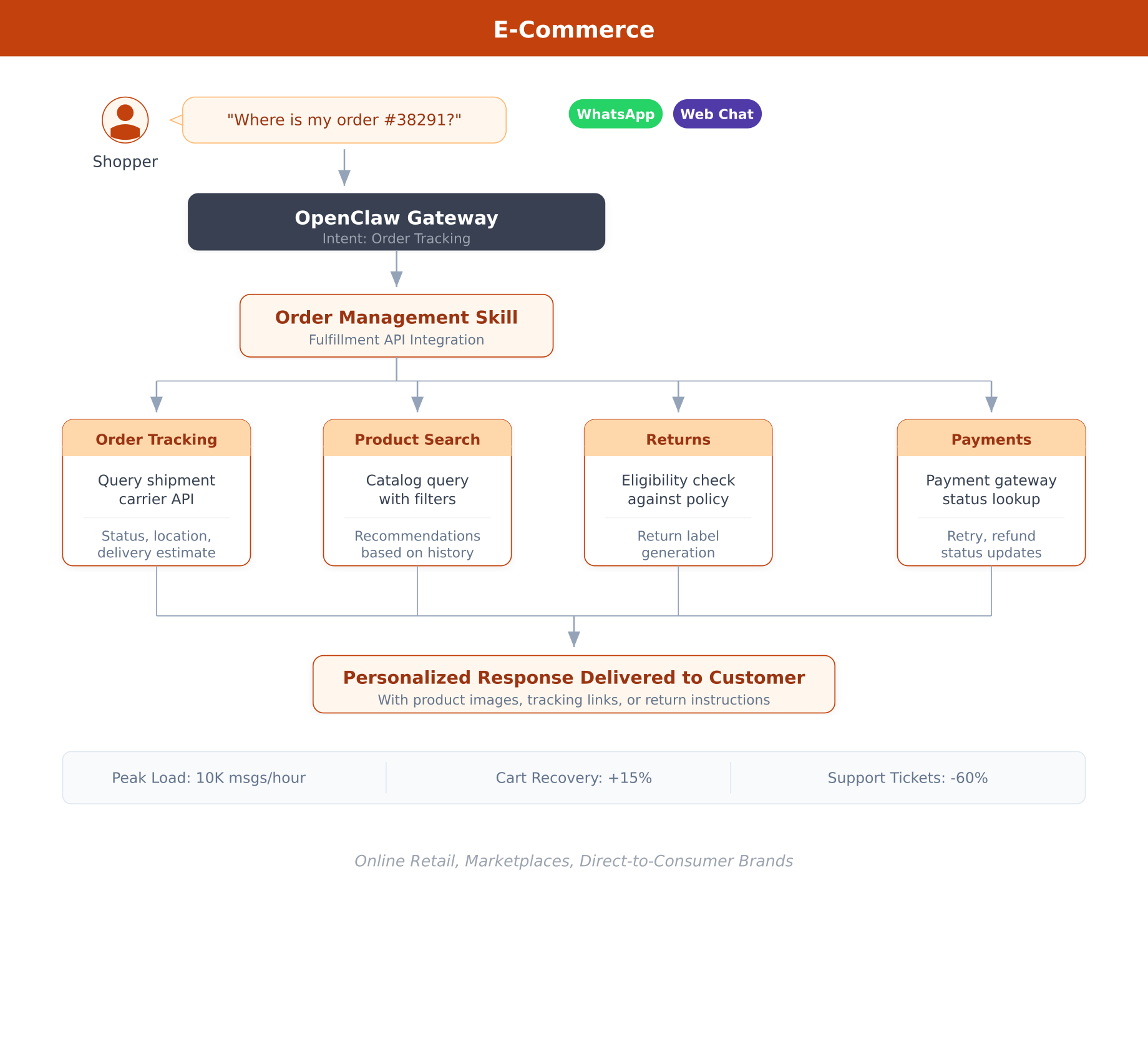
The e-commerce flow centers on an Order Management Skill that integrates with the fulfillment API and branches into four service paths. Order tracking queries the shipment carrier API for real-time status, location, and delivery estimates. Product search runs catalog queries with filters and generates recommendations based on purchase history. The returns branch checks eligibility against the store’s return policy and generates return labels automatically. Payment assistance handles gateway status lookups, retry attempts, and refund status updates. All four branches converge into a personalized response delivered back to the customer with product images, tracking links, or return instructions embedded directly in the chat message.
Without OpenClaw
- Customers submit tickets for order status and wait hours for a reply that could have been a simple API lookup
- Return eligibility checked manually by agents, leading to slow turnaround and inconsistent policy application
- Cart abandonment inquiries go unaddressed because support teams prioritize post-purchase issues
- Payment failures frustrate customers who have no self-service way to check gateway status or retry
With OpenClaw
- Real-time order tracking with carrier location, delivery estimate, and tracking link delivered in the chat
- Return labels generated automatically after policy eligibility is confirmed by the returns skill
- Product recommendations based on purchase history increase cross-sell opportunities during support conversations
- Payment retry and refund status updates handled instantly, reducing support ticket volume by up to 60%
Travel and Hospitality
Free to use, share it in your presentations, blogs, or learning materials.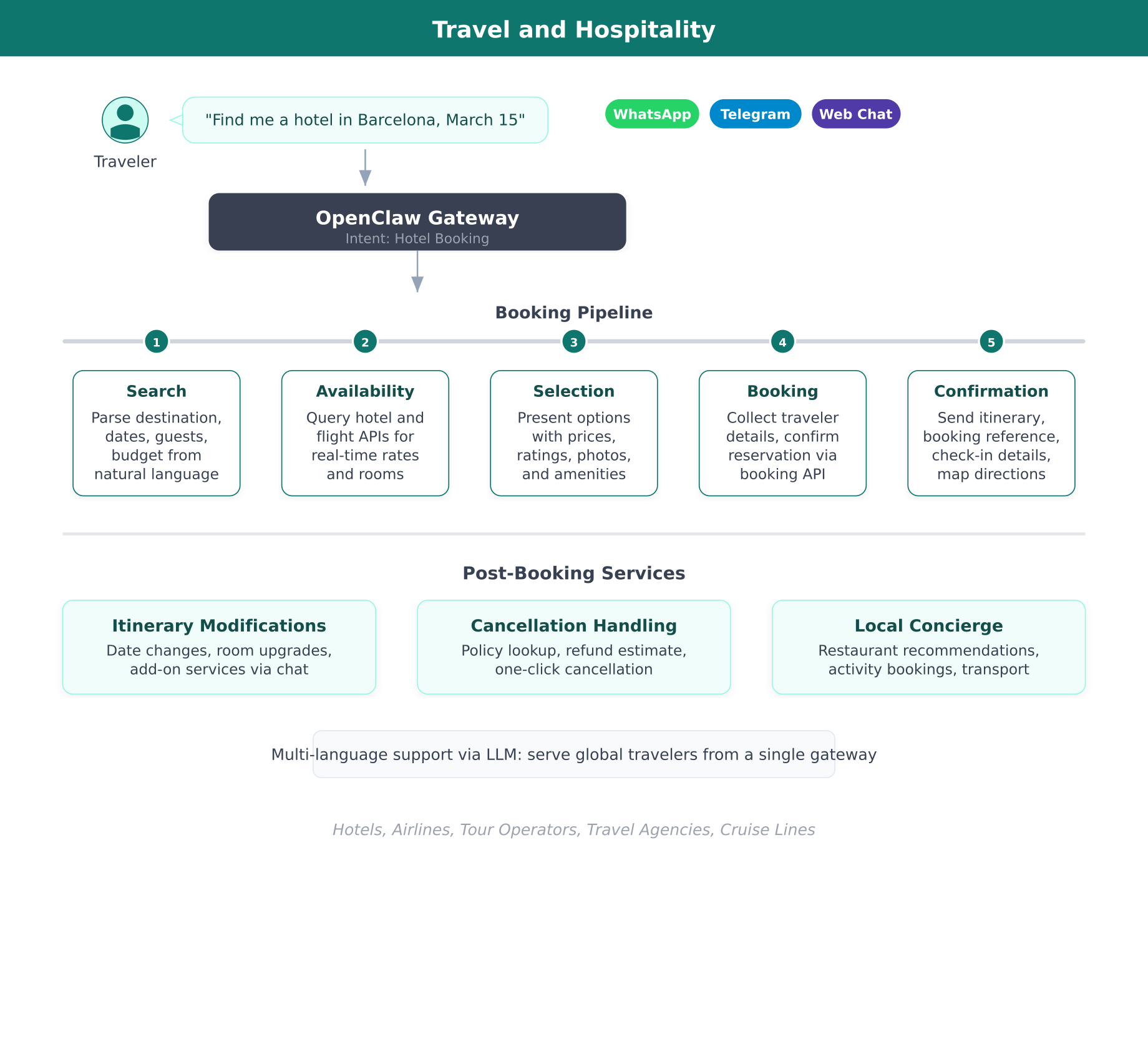
Travel bookings follow a five-phase pipeline visualized as a horizontal timeline. The search phase parses destination, dates, guest count, and budget from natural language. The availability phase queries hotel and flight APIs for real-time rates. Selection presents curated options with prices, ratings, photos, and amenities. The booking phase collects traveler details and confirms the reservation through the provider’s API. Confirmation delivers the itinerary, booking reference, check-in instructions, and map directions. Three post-booking services extend the agent’s value: itinerary modifications for date changes and room upgrades, cancellation handling with policy-aware refund estimates, and a local concierge for restaurant recommendations and activity bookings. Multi-language support through the LLM layer allows a single gateway instance to serve travelers regardless of their preferred language.
Without OpenClaw
- Travelers call reservation desks and wait on hold while agents manually search availability across multiple booking systems
- Itinerary changes and cancellations require phone calls during business hours, often across time zones
- Non-English-speaking travelers face language barriers with call center staff limited to one or two languages
- Post-booking support like restaurant recommendations or transport guidance is unavailable outside concierge desk hours
With OpenClaw
- Natural language search parses destination, dates, budget, and guest count from a single conversational message
- Real-time availability and booking confirmation delivered end-to-end through the chat without switching platforms
- Post-booking modifications, cancellations with refund estimates, and local recommendations available 24/7
- Multi-language support through the LLM serves global travelers from a single gateway instance
Education
Free to use, share it in your presentations, blogs, or learning materials.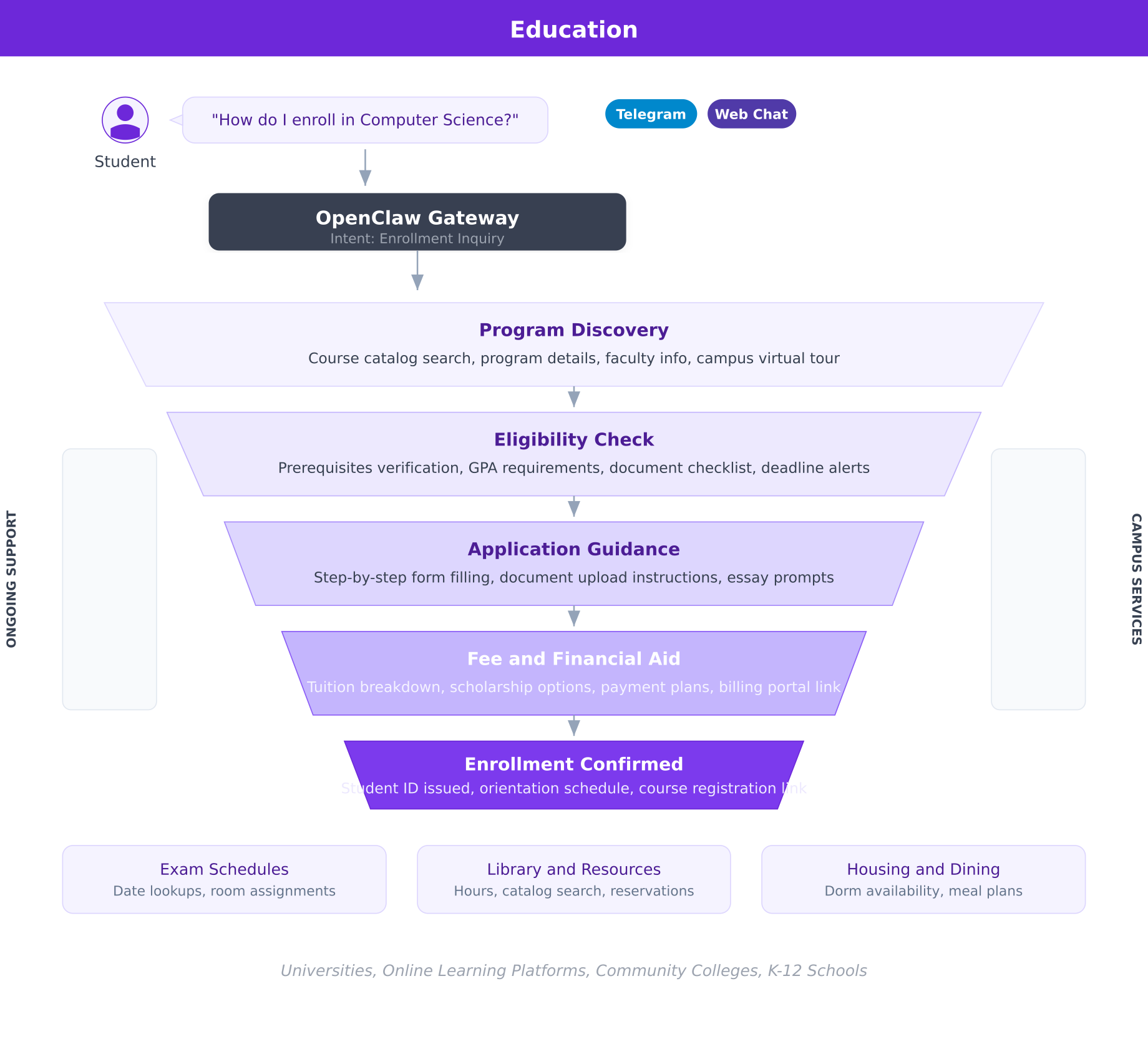
The education flow uses a funnel visualization that narrows as the student progresses through enrollment stages. Program discovery at the top covers course catalog search, program details, faculty information, and campus virtual tours. The eligibility check verifies prerequisites, GPA requirements, and provides a document checklist with deadline alerts. Application guidance walks students through form filling, document uploads, and essay prompts step by step. The fee and financial aid stage provides tuition breakdowns, scholarship options, payment plan details, and billing portal links. At the bottom, enrollment confirmation issues the student ID, orientation schedule, and course registration link. Flanking the funnel, ongoing support and campus services handle exam schedules, library resources, and housing and dining inquiries throughout the academic year.
Without OpenClaw
- Prospective students email admissions offices and wait days for replies about program eligibility or deadlines
- Enrollment counselors repeat the same prerequisite and fee information hundreds of times each admission cycle
- Application drop-off rates spike when students get stuck on a form step and have no immediate guidance
- Campus service inquiries (library hours, housing, dining) overwhelm help desks during the start of each semester
With OpenClaw
- Instant answers on program details, prerequisites, and deadlines through Telegram or web chat at any hour
- Step-by-step application guidance reduces form abandonment and keeps students moving through the funnel
- Financial aid breakdowns, scholarship options, and payment plan links delivered in a single conversation
- Ongoing campus services (exam schedules, library, housing) handled by the same agent year-round